CFG-free Distillation: Guidance 없이 빠른 생성
Classifier-Free Guidance의 2배 연산 비용 제거. 단일 forward pass로 동일 품질 달성.
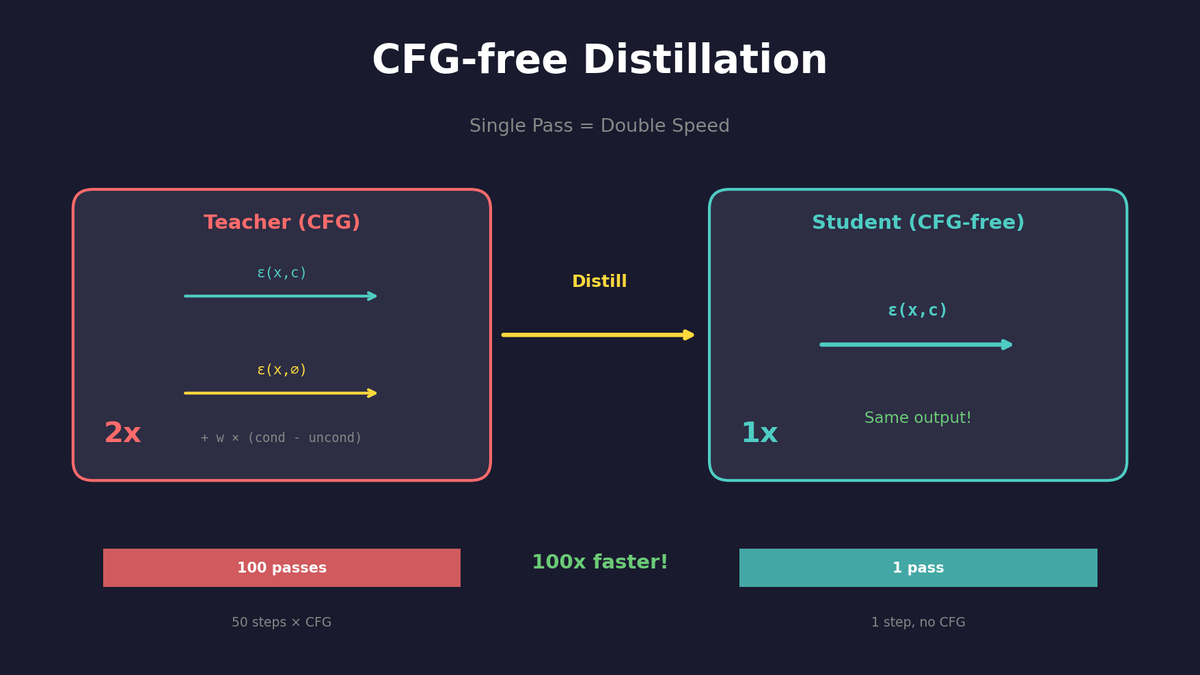
CFG-free Distillation: Guidance 없이 빠른 생성
Classifier-Free Guidance의 2배 연산 비용을 제거. 단일 forward pass로 CFG 품질 달성.
TL;DR
- 문제: CFG는 조건부/무조건부 두 번의 forward pass 필요 (2배 비용)
- 해결: Distillation으로 CFG 효과를 단일 모델에 학습
- 방법: Teacher의 CFG 출력을 Student가 모방
- 결과: 동일 품질, 절반의 연산량, 더 빠른 추론
1. Classifier-Free Guidance 복습
CFG란?
조건부 생성의 품질을 높이는 핵심 기법:
- $\epsilon(x_t, c)$: 조건부 예측
- $\epsilon(x_t, \varnothing)$: 무조건부 예측
- $w$: guidance scale (보통 7.5)
CFG의 문제점
| 문제 | 설명 |
|---|---|
| 2x 연산량 | 매 step마다 두 번의 forward pass |
| 메모리 증가 | 배치 크기 실질적 2배 |
| 지연 시간 | 추론 속도 절반으로 감소 |
실시간 애플리케이션에서 치명적!
2. CFG Distillation 아이디어
핵심 통찰
CFG의 출력을 **직접 예측**하도록 학습하면?
Teacher (CFG 사용):
2 forward passes → CFG 결합 → 출력Student (CFG-free):
1 forward pass → 동일한 출력Distillation 목표
Student가 Teacher의 CFG 결과를 모방.
3. 학습 방법
기본 알고리즘
def cfg_distillation_loss(student, teacher, x0, c, w=7.5):
    # 노이즈 추가
    t = torch.rand(x0.shape[0], device=x0.device)
    noise = torch.randn_like(x0)
    x_t = add_noise(x0, t, noise)

    # Teacher: CFG 적용
    with torch.no_grad():
        eps_cond = teacher(x_t, t, c)
        eps_uncond = teacher(x_t, t, null_cond)
        eps_cfg = eps_uncond + w * (eps_cond - eps_uncond)

    # Student: 단일 예측
    eps_student = student(x_t, t, c)

    return F.mse_loss(eps_student, eps_cfg)
Guidance Scale 조건화
다양한 guidance scale을 지원하려면:
def cfg_distillation_with_scale(student, teacher, x0, c):
    # 랜덤 guidance scale 샘플링
    w = torch.rand(x0.shape[0], device=x0.device) * 10 + 1  # [1, 11]

    # Teacher CFG
    with torch.no_grad():
        eps_cfg = compute_cfg(teacher, x_t, t, c, w)

    # Student: scale도 입력으로
    eps_student = student(x_t, t, c, w)

    return F.mse_loss(eps_student, eps_cfg)
이렇게 하면 추론 시 guidance scale 조절 가능!
4. 아키텍처 수정
Guidance Scale 임베딩
class CFGFreeUNet(nn.Module):
    def __init__(self, base_unet):
        super().__init__()
        self.unet = base_unet
        # Guidance scale 임베딩
        self.w_embed = nn.Sequential(
            nn.Linear(1, 256),
            nn.SiLU(),
            nn.Linear(256, 256)
        )

    def forward(self, x, t, c, w):
        # w를 시간 임베딩에 추가
        t_emb = self.time_embed(t)
        w_emb = self.w_embed(w.unsqueeze(-1))
        combined_emb = t_emb + w_emb

        return self.unet(x, combined_emb, c)
또는 간단한 방식
고정 guidance scale만 사용한다면:
- 아키텍처 수정 불필요
- 특정 w 값으로만 distillation
5. Progressive Distillation과 결합
CFG + Step Distillation
SDXL-Turbo, SDXL-Lightning 등의 접근:
def combined_distillation(student, teacher, x0, c):
    # 1. Step distillation (2 steps → 1 step)
    t = sample_timestep()
    t_mid = t / 2

    x_t = add_noise(x0, t)

    # Teacher: 2 steps with CFG
    with torch.no_grad():
        # Step 1
        eps1 = compute_cfg(teacher, x_t, t, c, w=7.5)
        x_mid = denoise_step(x_t, eps1, t, t_mid)

        # Step 2
        eps2 = compute_cfg(teacher, x_mid, t_mid, c, w=7.5)
        x_target = denoise_step(x_mid, eps2, t_mid, 0)

    # Student: 1 step, no CFG
    x_pred = student.denoise(x_t, t, c)

    return F.mse_loss(x_pred, x_target)
최종 목표
| Model | Steps | CFG | Forward Passes |
|---|---|---|---|
| SD 1.5 | 50 | Yes | 100 |
| SDXL-Turbo | 1 | No | 1 |
100배 속도 향상!
6. 구현 예제
간단한 CFG-free Distillation
class CFGFreeDistillation:
    def __init__(self, student, teacher, guidance_scale=7.5):
        self.student = student
        self.teacher = teacher
        self.w = guidance_scale

        # Teacher는 학습하지 않음
        for p in teacher.parameters():
            p.requires_grad = False

    def compute_teacher_cfg(self, x_t, t, c):
        """Teacher의 CFG 출력 계산"""
        # 조건부 예측
        eps_cond = self.teacher(x_t, t, c)

        # 무조건부 예측 (null condition)
        null_c = torch.zeros_like(c)
        eps_uncond = self.teacher(x_t, t, null_c)

        # CFG 결합
        return eps_uncond + self.w * (eps_cond - eps_uncond)

    def loss(self, x0, c):
        B = x0.shape[0]

        # 노이즈 샘플링
        t = torch.rand(B, device=x0.device)
        noise = torch.randn_like(x0)

        # Forward diffusion
        sigma = t.view(B, 1, 1, 1)
        x_t = x0 + sigma * noise

        # Teacher CFG target
        with torch.no_grad():
            target = self.compute_teacher_cfg(x_t, t, c)

        # Student prediction
        pred = self.student(x_t, t, c)

        return F.mse_loss(pred, target)
학습 루프
def train_cfg_free(student, teacher, dataloader, epochs=100):
    distiller = CFGFreeDistillation(student, teacher)
    optimizer = torch.optim.AdamW(student.parameters(), lr=1e-4)

    for epoch in range(epochs):
        for images, captions in dataloader:
            # 텍스트 인코딩
            c = text_encoder(captions)

            loss = distiller.loss(images, c)

            optimizer.zero_grad()
            loss.backward()
            optimizer.step()

        print(f"Epoch {epoch}: loss = {loss.item():.4f}")
7. Variational Score Distillation
문제점
단순 distillation의 한계:
- Mode collapse 가능성
- Teacher의 한계를 그대로 상속
- 다양성 감소
VSD 접근
Score Distillation Sampling을 활용:
Adversarial Distillation
GAN loss 추가:
def adversarial_distillation_loss(student, teacher, discriminator, x0, c):
    # Distillation loss
    dist_loss = cfg_distillation_loss(student, teacher, x0, c)

    # Generate sample
    z = torch.randn_like(x0)
    x_gen = student.sample(z, c)

    # Adversarial loss
    adv_loss = -discriminator(x_gen, c).mean()

    return dist_loss + 0.1 * adv_loss
8. 실제 모델들
SDXL-Turbo
Stability AI의 접근:
- Adversarial Diffusion Distillation (ADD)
- CFG-free + 1-4 step generation
- GAN discriminator 사용
SDXL-Lightning
ByteDance의 접근:
- Progressive distillation
- CFG distillation
- LoRA 기반 효율적 학습
LCM (Latent Consistency Models)
Consistency distillation + CFG:
- Consistency loss로 step 감소
- CFG 효과 내재화
9. 품질 비교
정량적 결과
| Model | Steps | CFG | FID | CLIP Score |
|---|---|---|---|---|
| SDXL | 50 | 7.5 | 23.5 | 0.32 |
| SDXL-Turbo | 1 | No | 24.1 | 0.31 |
| SDXL-Lightning | 4 | No | 23.8 | 0.32 |
| LCM-SDXL | 4 | No | 24.5 | 0.31 |
거의 동등한 품질, 압도적 속도 향상!
속도 비교 (A100 기준)
| Model | Time/Image |
|---|---|
| SDXL 50 steps + CFG | 3.2s |
| SDXL-Turbo 1 step | 0.08s |
40배 빠름!
10. 한계와 미래
현재 한계
| 한계 | 설명 |
|---|---|
| Teacher 의존 | Teacher 품질이 상한선 |
| 학습 비용 | 대규모 데이터 필요 |
| 유연성 감소 | Guidance scale 고정 또는 제한적 |
미래 방향
- Self-Distillation: Teacher 없이 자체 개선
- Continuous Guidance: 임의의 w 값 지원
- Multi-Modal Guidance: 여러 조건 동시 처리
결론
| 방법 | CFG 필요 | Steps | 속도 |
|---|---|---|---|
| 기본 Diffusion | Yes | 50+ | 1x |
| CFG Distillation | No | 50+ | 2x |
| + Step Distillation | No | 1-4 | 25-100x |
CFG-free Distillation의 핵심:
- Teacher의 CFG 효과를 Student에 증류
- 2배 연산량 제거
- Step distillation과 결합하면 수십 배 속도 향상
- 실시간 이미지 생성 가능
References
- Sauer, A., et al. "Adversarial Diffusion Distillation" (2023)
- Lin, S., et al. "SDXL-Lightning" (2024)
- Luo, S., et al. "Latent Consistency Models" (2023)
- Ho, J., Salimans, T. "Classifier-Free Diffusion Guidance" (2022)
- Meng, C., et al. "On Distillation of Guided Diffusion Models" (CVPR 2023)
이메일로 받아보기
관련 포스트
SDFT: 자기 증류로 망각 없이 학습하기
복잡한 강화학습 없이, 모델이 스스로를 선생님 삼아 새로운 기술을 배우면서도 기존 능력을 유지하는 방법.
Qwen3-Max-Thinking 스냅샷 공개: 추론형 AI의 새로운 기준
최근 LLM 시장의 트렌드는 단순히 '더 많은 데이터'를 학습하는 것을 넘어, 모델이 '어떻게 생각하느냐'에 집중하고 있습니다. 알리바바 클라우드(Alibaba Cloud)가 자사의 가장 강력한 모델 Qwen3-Max-Thinking의 API 스냅샷(qwen3-max-2026-01-23)을 공개했습니다.
YOLO26: Upgrade or Hype? 완벽 가이드
2026년 1월 출시된 YOLO26의 핵심 기능, YOLO11과의 성능 비교, 그리고 실제 업그레이드 가치가 있는지 실습과 함께 분석합니다.