DDIM: 20x Faster Diffusion Sampling with Zero Quality Loss (1000→50 Steps)
Use your DDPM pretrained model as-is but sample 20x faster. Mathematical derivation of probabilistic→deterministic conversion and eta parameter tuning.

DDIM: Fast Diffusion Sampling - From 1000 Steps to 50 Steps
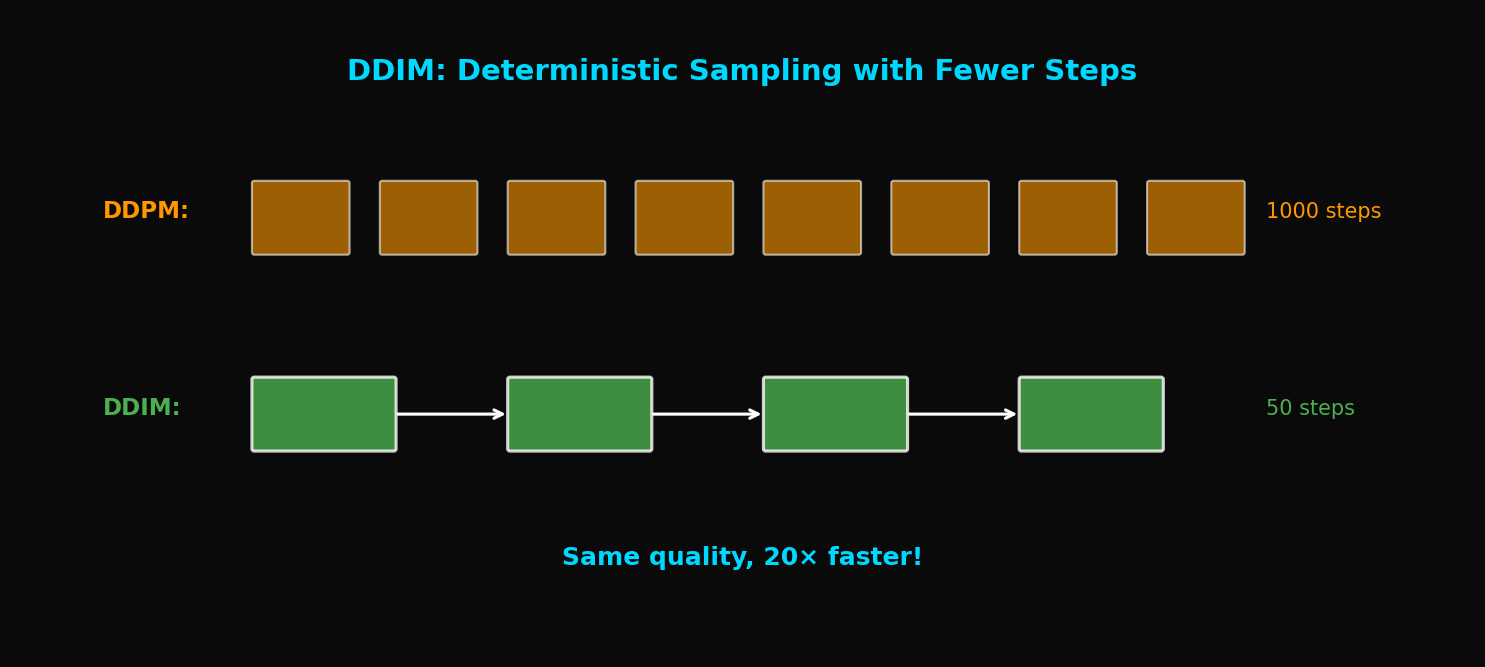
TL;DR: DDIM transforms DDPM's stochastic sampling into deterministic sampling, enabling 20x faster sampling. It uses the same pretrained model with nearly no quality loss.
1. DDPM's Speed Problem
1.1 Why Are 1000 Steps Necessary?
DDPM's sampling process:
Problem: Each step must be executed sequentially
- Cannot parallelize on GPU
- Requires 1000 forward passes
- ~20 seconds per image
1.2 Speed vs Quality Trade-off (DDPM)
What happens if we simply reduce steps in DDPM?
| Steps | FID ↓ | Generation Time |
|---|---|---|
| 1000 | 3.17 | 20s |
| 500 | 4.82 | 10s |
| 100 | 15.3 | 2s |
| 50 | 35.7 | 1s |
Quality degrades dramatically.
1.3 DDIM's Key Insight
Song et al.'s discovery:
"DDPM's trained model defines a more general non-Markovian process. By leveraging this, we can sample with fewer steps."
2. From DDPM to DDIM
2.1 DDPM Review
DDPM's forward process:
Reverse process:
Characteristic: A stochastic process that adds noise at each step
2.2 Generalized Forward Process
DDIM defines a more general forward process:
Where:
Key: controls the amount of noise
2.3 Special Cases of
$\sigma_t = \sqrt{\frac{1-\bar{\alpha}_{t-1}}{1-\bar{\alpha}_t}} \sqrt{1-\frac{\bar{\alpha}_t}{\bar{\alpha}_{t-1}}}$ (DDPM):
Same stochastic process as original DDPM
$\sigma_t = 0$ (DDIM):
Completely deterministic!
3. Mathematical Derivation of DDIM
3.1 Computing Predicted
From learned noise prediction :
This is the estimated original image from current .
3.2 Computing Direction Vector
Direction from toward :
3.3 DDIM Update Rule
Moving to next step:
Geometric Interpretation:
3.4 Subsequence Sampling
DDIM's true power: Can use arbitrary subsequences
Instead of [1, 2, 3, ..., 1000]:
- [1, 21, 41, ..., 981] (50 steps)
- [1, 51, 101, ..., 951] (20 steps)
- [1, 101, 201, ..., 901] (10 steps)
def get_timestep_subsequence(total_steps, num_steps):
    """Generate evenly distributed timestep subsequence"""
    c = total_steps // num_steps
    return list(range(0, total_steps, c))[:num_steps]

# Example: 1000 steps → 50 steps
subsequence = get_timestep_subsequence(1000, 50)
# [0, 20, 40, 60, ..., 980]
4. DDIM Implementation
4.1 Core Sampling Code
class DDIM:
    def __init__(self, model, T=1000, beta_start=1e-4, beta_end=0.02):
        self.model = model
        self.T = T

        # Same schedule as DDPM
        betas = torch.linspace(beta_start, beta_end, T)
        alphas = 1 - betas
        self.alpha_bars = torch.cumprod(alphas, dim=0)

    @torch.no_grad()
    def sample(self, shape, device, num_steps=50, eta=0.0):
        """
        DDIM Sampling

        Args:
            shape: Output shape (batch, channels, height, width)
            device: cuda/cpu
            num_steps: Number of sampling steps
            eta: Noise coefficient (0=deterministic, 1=DDPM)
        """
        # Generate timestep subsequence
        timesteps = self._get_timesteps(num_steps)

        # x_T ~ N(0, I)
        x = torch.randn(shape, device=device)

        for i in tqdm(range(len(timesteps) - 1, -1, -1)):
            t = timesteps[i]
            t_prev = timesteps[i - 1] if i > 0 else 0

            # Current and previous alpha_bar
            alpha_bar = self.alpha_bars[t]
            alpha_bar_prev = self.alpha_bars[t_prev] if t_prev > 0 else torch.tensor(1.0)

            # Predict noise
            t_batch = torch.full((shape[0],), t, device=device)
            epsilon_pred = self.model(x, t_batch)

            # Predict x_0
            x0_pred = (x - torch.sqrt(1 - alpha_bar) * epsilon_pred) / torch.sqrt(alpha_bar)
            x0_pred = torch.clamp(x0_pred, -1, 1)  # Clamp range

            # Direction (pointing to x_t)
            dir_xt = torch.sqrt(1 - alpha_bar_prev - eta**2 * self._get_variance(t, t_prev)) * epsilon_pred

            # Stochastic component (only when eta > 0)
            if eta > 0 and t > 0:
                noise = torch.randn_like(x)
                sigma = eta * torch.sqrt(self._get_variance(t, t_prev))
            else:
                noise = 0
                sigma = 0

            # DDIM update
            x = torch.sqrt(alpha_bar_prev) * x0_pred + dir_xt + sigma * noise

        return x

    def _get_timesteps(self, num_steps):
        """Generate evenly spaced timesteps"""
        c = self.T // num_steps
        return list(range(0, self.T, c))

    def _get_variance(self, t, t_prev):
        """Compute DDPM variance"""
        alpha_bar = self.alpha_bars[t]
        alpha_bar_prev = self.alpha_bars[t_prev] if t_prev > 0 else torch.tensor(1.0)
        return (1 - alpha_bar_prev) / (1 - alpha_bar) * (1 - alpha_bar / alpha_bar_prev)
4.2 Eta () Parameter
controls the stochasticity of sampling:
| $\eta$ | Characteristic | Use Case |
|---|---|---|
| 0 | Fully deterministic | Interpolation, Inversion |
| 1 | Same as DDPM | When diversity needed |
| 0~1 | In between | Trade-off adjustment |
# Deterministic sampling (reproducible)
samples_deterministic = ddim.sample(shape, device, num_steps=50, eta=0.0)

# Stochastic sampling (more diverse)
samples_stochastic = ddim.sample(shape, device, num_steps=50, eta=1.0)
5. Experimental Results
5.1 Quality Comparison by Step Count
CIFAR-10 FID:
| Steps | DDPM | DDIM ($\eta=0$) |
|---|---|---|
| 1000 | 3.17 | 4.16 |
| 100 | 15.3 | 4.67 |
| 50 | 35.7 | 4.89 |
| 20 | 78.2 | 6.84 |
| 10 | 143.5 | 13.36 |
DDIM at 50 steps achieves similar quality to DDPM at 1000 steps!
5.2 Speed Improvement
| Method | Steps | Time | FID |
|---|---|---|---|
| DDPM | 1000 | 20s | 3.17 |
| DDIM | 50 | 1s | 4.89 |
| DDIM | 20 | 0.4s | 6.84 |
20x speed improvement with minimal quality loss!
5.3 Results on Various Datasets
| Dataset | Resolution | DDPM (1000) | DDIM (50) |
|---|---|---|---|
| CIFAR-10 | 32×32 | 3.17 | 4.89 |
| CelebA | 64×64 | 3.51 | 5.12 |
| LSUN Bedroom | 256×256 | 4.89 | 6.53 |
6. Special Applications of DDIM
6.1 Deterministic Encoding (Inversion)
When , the process is invertible:
def ddim_inversion(ddim, x_0, num_steps=50):
    """Encode image to latent"""
    timesteps = ddim._get_timesteps(num_steps)

    x = x_0

    for i in range(len(timesteps) - 1):
        t = timesteps[i]
        t_next = timesteps[i + 1]

        alpha_bar = ddim.alpha_bars[t]
        alpha_bar_next = ddim.alpha_bars[t_next]

        # Predict noise
        epsilon_pred = ddim.model(x, t)

        # Predict x_0
        x0_pred = (x - torch.sqrt(1 - alpha_bar) * epsilon_pred) / torch.sqrt(alpha_bar)

        # Move to next step (reverse direction)
        x = torch.sqrt(alpha_bar_next) * x0_pred + torch.sqrt(1 - alpha_bar_next) * epsilon_pred

    return x  # x_T (latent)
6.2 Image Interpolation
Smoothly interpolate between two images:
def interpolate_images(ddim, img1, img2, num_interp=5, num_steps=50):
    """Interpolate between two images"""
    # 1. Encode both images to latent
    z1 = ddim_inversion(ddim, img1, num_steps)
    z2 = ddim_inversion(ddim, img2, num_steps)

    # 2. Linear interpolation in latent space
    interpolations = []
    for alpha in torch.linspace(0, 1, num_interp):
        z_interp = (1 - alpha) * z1 + alpha * z2

        # 3. Decode interpolated latent to image
        img_interp = ddim.sample_from_latent(z_interp, num_steps)
        interpolations.append(img_interp)

    return torch.stack(interpolations)
6.3 Image Editing
def edit_image(ddim, image, edit_direction, strength=0.5, num_steps=50):
    """Edit image (e.g., age change, expression change)"""
    # 1. Encode image to latent
    z = ddim_inversion(ddim, image, num_steps)

    # 2. Apply edit direction
    z_edited = z + strength * edit_direction

    # 3. Decode edited latent to image
    edited_image = ddim.sample_from_latent(z_edited, num_steps)

    return edited_image
7. Theoretical Analysis
7.1 Why Does DDIM Work?
Key Insight: DDPM's training objective is to learn
This objective is independent of the sampling method!
- DDPM: Stochastic sampling
- DDIM: Deterministic sampling
- Both use the same $\epsilon_\theta$
7.2 Non-Markovian Interpretation
DDIM's reverse process:
Conditional on → Non-Markovian
But since we estimate with , this is not a problem
7.3 ODE Formulation
In the continuous time limit, DDIM is a probability ODE:
Where
8. DDIM vs DDPM Comparison
8.1 Mathematical Differences
| Property | DDPM | DDIM |
|---|---|---|
| Sampling | Stochastic | Deterministic ($\eta=0$) |
| Reverse process | Markovian | Non-Markovian |
| Continuous interpretation | SDE | ODE |
| Invertibility | No | Yes |
8.2 Practical Differences
| Property | DDPM | DDIM |
|---|---|---|
| Minimum steps | ~1000 | ~20-50 |
| Diversity | High | Controllable |
| Reproducibility | No | Yes ($\eta=0$) |
| Inversion | Difficult | Easy |
8.3 When to Use Which?
Use DDPM:
- When highest quality is needed
- When diversity is important
- When there's no time constraint
Use DDIM:
- When fast sampling is needed
- When doing image editing/interpolation
- When reproducible results are needed
9. Implementation Tips
9.1 Choosing Optimal Step Count
def find_optimal_steps(ddim, val_images, step_options=[10, 20, 50, 100]):
    """Find optimal trade-off between quality and speed"""
    results = {}

    for num_steps in step_options:
        start = time.time()
        samples = ddim.sample(shape, device, num_steps=num_steps)
        elapsed = time.time() - start

        fid = calculate_fid(samples, val_images)
        results[num_steps] = {'fid': fid, 'time': elapsed}

    return results
Empirical Recommendations:
- Fast prototyping: 20 steps
- General use: 50 steps
- High quality needed: 100 steps
9.2 Choosing
# Reproducibility important: eta = 0
samples = ddim.sample(shape, device, eta=0.0)

# Diversity important: eta > 0
samples = ddim.sample(shape, device, eta=0.5)

# Same diversity as DDPM: eta = 1
samples = ddim.sample(shape, device, eta=1.0)
9.3 Combining with Classifier-Free Guidance
def ddim_sample_with_cfg(ddim, shape, device, num_steps, cfg_scale=7.5, condition=None):
    """Combine Classifier-Free Guidance with DDIM"""
    x = torch.randn(shape, device=device)
    timesteps = ddim._get_timesteps(num_steps)

    for t in reversed(timesteps):
        # Unconditional and conditional predictions
        eps_uncond = ddim.model(x, t, condition=None)
        eps_cond = ddim.model(x, t, condition=condition)

        # Apply CFG
        eps = eps_uncond + cfg_scale * (eps_cond - eps_uncond)

        # DDIM update (using eps)
        x = ddim_step(x, t, eps)

    return x
10. Conclusion
DDIM made a decisive contribution to the practicalization of Diffusion models:
- 20x faster sampling (1000 → 50 steps)
- Minimal quality loss (FID 3.17 → 4.89)
- Deterministic encoding possible (foundation for image editing)
- Reproducible results
Without DDIM, there would be no Stable Diffusion. In the next article, we'll cover Latent Diffusion: the innovation that enabled high-resolution image generation by performing diffusion in latent space instead of pixel space.
References
- Song, J., Meng, C., & Ermon, S. (2021). Denoising Diffusion Implicit Models. ICLR 2021
- Ho, J., Jain, A., & Abbeel, P. (2020). Denoising Diffusion Probabilistic Models. NeurIPS 2020
- Song, Y., et al. (2021). Score-Based Generative Modeling through Stochastic Differential Equations. ICLR 2021
- Dhariwal, P., & Nichol, A. (2021). Diffusion Models Beat GANs on Image Synthesis. NeurIPS 2021
Tags: #DDIM #Diffusion #Fast-Sampling #Deep-Learning #Image-Generation #Deterministic-Sampling #ODE
The complete code for this article is available in the attached Jupyter Notebook.
Subscribe to Newsletter
Related Posts
SDFT: Learning Without Forgetting via Self-Distillation
No complex RL needed. Models teach themselves to learn new skills while preserving existing capabilities.
Qwen3-Max-Thinking Snapshot Release: A New Standard in Reasoning AI
The recent trend in the LLM market goes beyond simply learning "more data" — it's now focused on "how the model thinks." Alibaba Cloud has released an API snapshot (qwen3-max-2026-01-23) of its most powerful model, Qwen3-Max-Thinking.
YOLO26: Upgrade or Hype? The Complete Guide
Analyzing YOLO26's key features released in January 2026, comparing performance with YOLO11, and determining if it's worth upgrading through hands-on examples.