DDPM Math Walkthrough: Deriving Forward/Reverse Process Step by Step
Generate high-quality images without GAN mode collapse. Derive every equation from β schedule to loss function and truly understand how DDPM works.

DDPM: The Beginning of Diffusion Models - Images Born from Noise
TL;DR: DDPM (Denoising Diffusion Probabilistic Model) progressively adds noise to images, then learns to reverse this process to generate images from noise. It's a revolutionary methodology that is mathematically rigorous while producing high-quality images.
1. What is a Diffusion Model?
1.1 History of Generative Models
The history of deep learning-based image generation:
| Year | Model | Characteristics |
|---|---|---|
| 2014 | GAN | Adversarial training, mode collapse issues |
| 2014 | VAE | Latent variables, blurry images |
| 2016 | PixelCNN | Autoregressive, very slow |
| 2019 | Flow | Invertible networks, memory intensive |
| **2020** | **DDPM** | **Diffusion process, high quality + stable** |
1.2 Core Idea
The intuition behind DDPM:
"If we learn the process of turning an image into pure noise, we can reverse that process to generate images from noise"
Forward Process (Adding Noise):
x₀ (original image) → x₁ → x₂ → ... → x_T (pure noise)
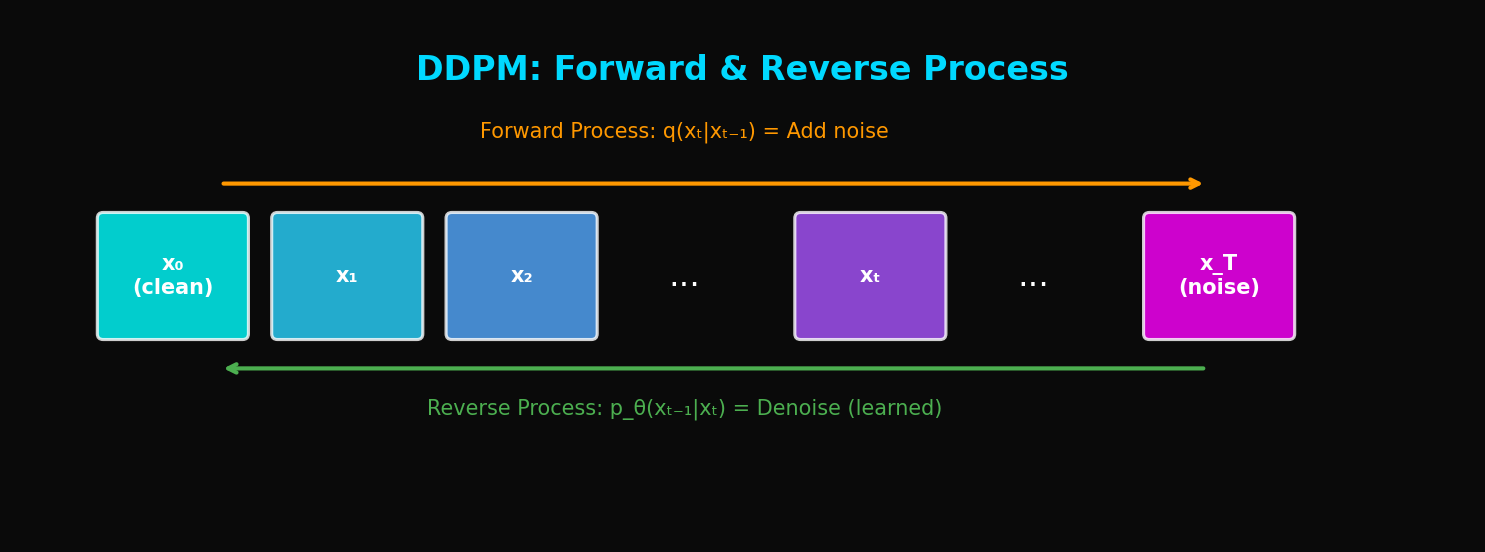
Reverse Process (Removing Noise):
x_T (pure noise) → x_{T-1} → ... → x₁ → x₀ (generated image)
1.3 Why "Diffusion"?
Physical Analogy: Think of ink diffusing in water.
- Forward: Ink spreads in water becoming uniform → Image becomes noise
- Reverse: Reversing this process → Image coalesces from noise
Probabilistic Interpretation: Connecting complex data distribution to simple distribution
2. Mathematical Foundations
2.1 Forward Process (Diffusion)
Starting from data , progressively add noise:
Where:
- : variance schedule (typically to )
- : total diffusion steps (typically 1000)
Full forward process:
2.2 Key Insight: Direct Jump to Any Timestep
Defining , :
Meaning: We can go directly from to !
2.3 Reverse Process (Denoising)
Reversing the forward process:
Key Question: How do we learn and ?
2.4 ELBO (Evidence Lower Bound)
Variational bound on log likelihood:
Expanding this:
2.5 Posterior Computation
Using Bayes' rule:
Where:
3. Reparameterization to Noise Prediction
3.1 Key Insight
Since :
Therefore, instead of predicting $x_0$, predict $\epsilon$:
3.2 Simplified Loss
The simple loss proposed by Ho et al.:
Interpretation: Train the network to predict the added noise
3.3 Training Algorithm
def train_step(model, x_0):
    # 1. Sample random timestep
    t = torch.randint(1, T+1, (batch_size,))

    # 2. Sample noise
    epsilon = torch.randn_like(x_0)

    # 3. Compute x_t (add noise)
    alpha_bar_t = get_alpha_bar(t)
    x_t = sqrt(alpha_bar_t) * x_0 + sqrt(1 - alpha_bar_t) * epsilon

    # 4. Predict noise
    epsilon_pred = model(x_t, t)

    # 5. Compute loss
    loss = F.mse_loss(epsilon_pred, epsilon)

    return loss
4. Sampling Algorithm
4.1 Basic Sampling
@torch.no_grad()
def sample(model, shape):
    # x_T ~ N(0, I)
    x = torch.randn(shape)

    for t in reversed(range(1, T+1)):
        # Predict noise
        epsilon_pred = model(x, t)

        # Compute μ_θ
        alpha_t = get_alpha(t)
        alpha_bar_t = get_alpha_bar(t)
        beta_t = get_beta(t)

        mu = (1 / sqrt(alpha_t)) * (x - (beta_t / sqrt(1 - alpha_bar_t)) * epsilon_pred)

        # Add noise (only when t > 1)
        if t > 1:
            sigma = sqrt(beta_t)
            x = mu + sigma * torch.randn_like(x)
        else:
            x = mu

    return x
4.2 Variance Schedule
Linear Schedule (Original DDPM):
Cosine Schedule (Improved DDPM):
def cosine_beta_schedule(timesteps, s=0.008):
    steps = timesteps + 1
    x = torch.linspace(0, timesteps, steps)
    alphas_cumprod = torch.cos(((x / timesteps) + s) / (1 + s) * torch.pi * 0.5) ** 2
    alphas_cumprod = alphas_cumprod / alphas_cumprod[0]
    betas = 1 - (alphas_cumprod[1:] / alphas_cumprod[:-1])
    return torch.clip(betas, 0.0001, 0.9999)
5. U-Net Architecture
5.1 Overall Structure
The noise prediction network in DDPM uses a U-Net structure:
5.2 Time Embedding
Injecting timestep into the network:
class SinusoidalPositionEmbeddings(nn.Module):
    def __init__(self, dim):
        super().__init__()
        self.dim = dim

    def forward(self, t):
        half_dim = self.dim // 2
        embeddings = math.log(10000) / (half_dim - 1)
        embeddings = torch.exp(torch.arange(half_dim) * -embeddings)
        embeddings = t[:, None] * embeddings[None, :]
        embeddings = torch.cat((embeddings.sin(), embeddings.cos()), dim=-1)
        return embeddings
5.3 ResNet Block with Time Conditioning
class ResBlock(nn.Module):
    def __init__(self, in_channels, out_channels, time_emb_dim):
        super().__init__()
        self.time_mlp = nn.Linear(time_emb_dim, out_channels)
        self.conv1 = nn.Conv2d(in_channels, out_channels, 3, padding=1)
        self.conv2 = nn.Conv2d(out_channels, out_channels, 3, padding=1)
        self.norm1 = nn.GroupNorm(8, out_channels)
        self.norm2 = nn.GroupNorm(8, out_channels)

        if in_channels != out_channels:
            self.shortcut = nn.Conv2d(in_channels, out_channels, 1)
        else:
            self.shortcut = nn.Identity()

    def forward(self, x, t_emb):
        h = self.conv1(x)
        h = self.norm1(h)
        h = h + self.time_mlp(t_emb)[:, :, None, None]  # Time conditioning
        h = F.silu(h)
        h = self.conv2(h)
        h = self.norm2(h)
        h = F.silu(h)
        return h + self.shortcut(x)
5.4 Self-Attention in U-Net
class SelfAttention(nn.Module):
    def __init__(self, channels, num_heads=4):
        super().__init__()
        self.mha = nn.MultiheadAttention(channels, num_heads, batch_first=True)
        self.ln = nn.LayerNorm(channels)

    def forward(self, x):
        b, c, h, w = x.shape
        x = x.view(b, c, h*w).transpose(1, 2)  # (B, H*W, C)
        x_ln = self.ln(x)
        attn_out, _ = self.mha(x_ln, x_ln, x_ln)
        x = x + attn_out
        return x.transpose(1, 2).view(b, c, h, w)
6. Complete Implementation
6.1 Full U-Net Code
class UNet(nn.Module):
    def __init__(self, in_channels=3, model_channels=64, out_channels=3,
                 channel_mult=(1, 2, 4, 8), attention_resolutions=(16, 8)):
        super().__init__()

        self.time_embed = nn.Sequential(
            SinusoidalPositionEmbeddings(model_channels),
            nn.Linear(model_channels, model_channels * 4),
            nn.SiLU(),
            nn.Linear(model_channels * 4, model_channels * 4),
        )

        # Encoder
        self.encoder = nn.ModuleList()
        ch = model_channels
        for level, mult in enumerate(channel_mult):
            for _ in range(2):
                self.encoder.append(ResBlock(ch, model_channels * mult, model_channels * 4))
                ch = model_channels * mult
            if level != len(channel_mult) - 1:
                self.encoder.append(Downsample(ch))

        # Bottleneck
        self.bottleneck = nn.Sequential(
            ResBlock(ch, ch, model_channels * 4),
            SelfAttention(ch),
            ResBlock(ch, ch, model_channels * 4),
        )

        # Decoder
        self.decoder = nn.ModuleList()
        for level, mult in reversed(list(enumerate(channel_mult))):
            for i in range(3):
                skip_ch = ch if i == 0 else model_channels * mult
                self.decoder.append(ResBlock(ch + skip_ch, model_channels * mult, model_channels * 4))
                ch = model_channels * mult
            if level != 0:
                self.decoder.append(Upsample(ch))

        self.out = nn.Sequential(
            nn.GroupNorm(8, ch),
            nn.SiLU(),
            nn.Conv2d(ch, out_channels, 3, padding=1),
        )

    def forward(self, x, t):
        t_emb = self.time_embed(t)

        # Encoder with skip connections
        skips = []
        for module in self.encoder:
            if isinstance(module, ResBlock):
                x = module(x, t_emb)
                skips.append(x)
            else:  # Downsample
                x = module(x)

        # Bottleneck
        x = self.bottleneck[0](x, t_emb)
        x = self.bottleneck[1](x)
        x = self.bottleneck[2](x, t_emb)

        # Decoder with skip connections
        for module in self.decoder:
            if isinstance(module, ResBlock):
                x = torch.cat([x, skips.pop()], dim=1)
                x = module(x, t_emb)
            else:  # Upsample
                x = module(x)

        return self.out(x)
6.2 DDPM Class
class DDPM:
    def __init__(self, model, T=1000, beta_start=1e-4, beta_end=0.02):
        self.model = model
        self.T = T

        # Variance schedule
        self.betas = torch.linspace(beta_start, beta_end, T)
        self.alphas = 1 - self.betas
        self.alpha_bars = torch.cumprod(self.alphas, dim=0)

    def get_loss(self, x_0):
        batch_size = x_0.shape[0]
        t = torch.randint(1, self.T + 1, (batch_size,))

        epsilon = torch.randn_like(x_0)
        alpha_bar = self.alpha_bars[t - 1].view(-1, 1, 1, 1)

        x_t = torch.sqrt(alpha_bar) * x_0 + torch.sqrt(1 - alpha_bar) * epsilon
        epsilon_pred = self.model(x_t, t)

        return F.mse_loss(epsilon_pred, epsilon)

    @torch.no_grad()
    def sample(self, shape, device):
        x = torch.randn(shape, device=device)

        for t in tqdm(reversed(range(1, self.T + 1))):
            t_batch = torch.full((shape[0],), t, device=device)
            epsilon_pred = self.model(x, t_batch)

            alpha = self.alphas[t - 1]
            alpha_bar = self.alpha_bars[t - 1]
            beta = self.betas[t - 1]

            mu = (1 / torch.sqrt(alpha)) * (x - (beta / torch.sqrt(1 - alpha_bar)) * epsilon_pred)

            if t > 1:
                sigma = torch.sqrt(beta)
                x = mu + sigma * torch.randn_like(x)
            else:
                x = mu

        return x
7. Experimental Results
7.1 CIFAR-10 Benchmark
| Model | FID ↓ | IS ↑ |
|---|---|---|
| GAN (BigGAN) | 14.73 | 9.22 |
| VAE | 78.51 | - |
| PixelCNN | 65.93 | 4.60 |
| **DDPM** | **3.17** | **9.46** |
DDPM achieves overwhelmingly better FID!
7.2 Sample Quality
Characteristics of DDPM-generated images:
- Diversity: Diverse samples without mode collapse
- Detail: Sharp details even at high resolution
- Stability: Stable training
7.3 Drawback: Sampling Speed
| Model | Sampling Time (1 image) |
|---|---|
| GAN | ~0.01 sec |
| VAE | ~0.01 sec |
| **DDPM (T=1000)** | **~20 sec** |
Very slow due to 1000 steps → Solved by DDIM
8. Significance and Limitations of DDPM
8.1 Revolutionary Contributions
- Theoretical Foundation: Probabilistically rigorous framework
- Training Stability: No adversarial training like GAN
- Sample Quality: Achieved SOTA FID
- Diversity: No mode collapse
8.2 Limitations
- Slow Sampling: Requires 1000 steps
- High Resolution Difficult: Operates directly in pixel space
- Conditional Generation Difficult: Base model is unconditional
8.3 Follow-up Research Directions
| Problem | Solution | Paper |
|---|---|---|
| Slow Sampling | DDIM | Song et al. 2021 |
| High Resolution | Latent Diffusion | Rombach et al. 2022 |
| Conditional Generation | Classifier Guidance | Dhariwal et al. 2021 |
| Even Faster Sampling | Consistency Models | Song et al. 2023 |
9. Code Execution Examples
9.1 Training
# Setup
device = torch.device('cuda' if torch.cuda.is_available() else 'cpu')
model = UNet().to(device)
ddpm = DDPM(model)
optimizer = torch.optim.Adam(model.parameters(), lr=2e-4)

# Training loop
for epoch in range(100):
    for batch in dataloader:
        x_0 = batch[0].to(device)
        loss = ddpm.get_loss(x_0)

        optimizer.zero_grad()
        loss.backward()
        optimizer.step()

    print(f"Epoch {epoch}: Loss = {loss.item():.4f}")
9.2 Sampling
# Generate samples
samples = ddpm.sample(shape=(16, 3, 32, 32), device=device)

# Save images
save_image(samples, 'samples.png', nrow=4, normalize=True)
10. Conclusion
DDPM changed the paradigm of generative models:
- Simple idea of adding/removing noise
- Probabilistically rigorous framework
- Image quality surpassing GAN
- Stable training
However, there's a critical drawback of 1000-step sampling. In the next article, we'll cover DDIM which reduces this to 50 steps.
References
- Ho, J., Jain, A., & Abbeel, P. (2020). Denoising Diffusion Probabilistic Models. NeurIPS 2020
- Sohl-Dickstein, J., et al. (2015). Deep Unsupervised Learning using Nonequilibrium Thermodynamics. ICML 2015
- Song, Y., & Ermon, S. (2019). Generative Modeling by Estimating Gradients of the Data Distribution. NeurIPS 2019
- Nichol, A., & Dhariwal, P. (2021). Improved Denoising Diffusion Probabilistic Models. ICML 2021
Tags: #DDPM #Diffusion #Generative-Models #Deep-Learning #Image-Generation #U-Net #Denoising
The complete code for this article is available in the attached Jupyter Notebook.
Subscribe to Newsletter
Related Posts
SDFT: Learning Without Forgetting via Self-Distillation
No complex RL needed. Models teach themselves to learn new skills while preserving existing capabilities.
Qwen3-Max-Thinking Snapshot Release: A New Standard in Reasoning AI
The recent trend in the LLM market goes beyond simply learning "more data" — it's now focused on "how the model thinks." Alibaba Cloud has released an API snapshot (qwen3-max-2026-01-23) of its most powerful model, Qwen3-Max-Thinking.
YOLO26: Upgrade or Hype? The Complete Guide
Analyzing YOLO26's key features released in January 2026, comparing performance with YOLO11, and determining if it's worth upgrading through hands-on examples.