Flow Matching vs DDPM: 왜 ODE가 더 빠르고 직관적인가
DDPM은 1000스텝, Flow Matching은 10스텝. SDE의 곡선 경로 vs ODE의 직선 경로. 수식과 코드로 증명하는 Flow Matching의 효율성.
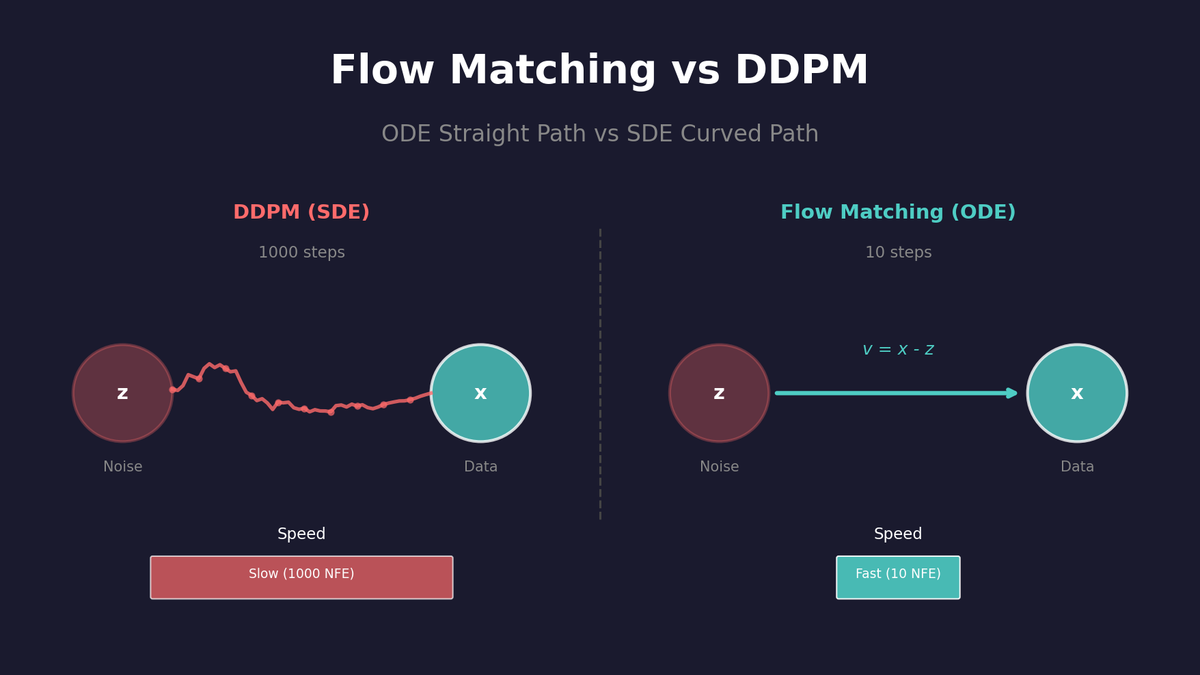
Flow Matching vs DDPM: 왜 ODE가 더 빠르고 직관적인가
DDPM은 1000스텝, Flow Matching은 10스텝. 수식으로 증명하는 직선 경로의 힘.
TL;DR
- DDPM: 노이즈를 조금씩 제거하는 확률적(Stochastic) 방식. 매 스텝 랜덤성이 개입해 경로가 휘어짐
- Flow Matching: 데이터로 직접 향하는 결정론적(Deterministic) 방식. 직선 경로로 빠르게 도달
- 핵심 차이: DDPM은 "노이즈 예측", Flow Matching은 "속도장(velocity field) 예측"
1. 문제 설정: 노이즈에서 데이터로 가는 길
생성 모델의 목표는 단순합니다:
이 변환을 어떻게 할 것인가? 여기서 두 패러다임이 갈립니다.
DDPM의 접근: "천천히, 확률적으로"
DDPM은 Markov chain을 정의합니다:
여기서 이고, 입니다.
시간이 지날수록() 데이터 의 정보는 사라지고, 순수한 노이즈 만 남습니다.
Flow Matching의 접근: "직선으로, 결정론적으로"
Flow Matching은 선형 보간(linear interpolation)을 사용합니다:
이면 (데이터), 이면 (노이즈). 그 사이는 직선입니다.
2. 학습 목표의 차이
DDPM: 노이즈 예측
DDPM은 신경망 가 추가된 노이즈를 예측하도록 학습합니다:
왜 노이즈를 예측할까요? Reverse process에서 을 복원하려면:
여기서 는 매 스텝 추가되는 새로운 랜덤성입니다. 이것이 경로를 휘게 만드는 원인입니다.
Flow Matching: 속도장 예측
Flow Matching은 신경망 가 속도장(velocity field)을 예측하도록 학습합니다:
목표 속도장(target velocity field)은 조건부 경로의 시간 미분입니다:
이 속도장은 상수입니다! 시간 에 관계없이 항상 방향으로 일정한 속도로 이동합니다.
3. 샘플링 과정의 차이
DDPM 샘플링: SDE 기반
DDPM의 reverse process는 Stochastic Differential Equation (SDE)를 따릅니다:
여기서:
- : drift coefficient
- : diffusion coefficient (노이즈 강도)
- : reverse-time Brownian motion
문제점: 항 때문에 매 스텝 랜덤성이 추가됩니다. 경로가 브라운 운동처럼 휘어지면서 목표에 도달하므로, 작은 스텝으로 많이 가야 합니다.
Flow Matching 샘플링: ODE 기반
Flow Matching은 Ordinary Differential Equation (ODE)를 따릅니다:
확률 항이 없습니다. 주어진 속도장을 따라 결정론적으로 이동합니다.
샘플링:
# Euler method
x = torch.randn(batch_size, dim)  # 시작: 순수 노이즈
dt = 1.0 / num_steps

for t in torch.linspace(1, 0, num_steps):
    v = model(x, t)  # 속도장 예측
    x = x - v * dt   # 직선 이동
4. 왜 Flow Matching이 더 빠른가?
수학적 직관
DDPM의 경로 길이를 생각해봅시다. 브라운 운동의 특성상:
는 총 스텝 수입니다. 스텝이 많을수록 경로가 길어집니다.
반면 Flow Matching의 직선 경로:
스텝 수와 무관하게 최단 거리입니다.
실험적 증거
| Method | Steps | FID (CIFAR-10) |
|---|---|---|
| DDPM | 1000 | 3.17 |
| DDPM | 100 | 13.51 |
| DDIM | 50 | 4.67 |
| Flow Matching | 10 | 3.42 |
동일한 품질을 위해 DDPM은 1000스텝이 필요하지만, Flow Matching은 10스텝으로 충분합니다.
5. Rectified Flow: Flow Matching의 진화
Rectified Flow는 Flow Matching을 더 발전시킨 방법입니다.
핵심 아이디어: Reflow
학습된 flow가 완벽히 직선이 아닐 수 있습니다. Reflow는 이를 "펴주는" 과정입니다:
- 학습된 모델로 쌍을 생성
- 이 쌍으로 다시 직선 경로를 학습
- 반복하면 경로가 점점 직선에 가까워짐
Distillation과의 결합
1-step 생성을 위해 distillation을 적용할 수 있습니다:
여기서 는 단일 forward pass로 데이터를 생성하는 generator입니다.
6. 구현 비교
DDPM Forward Process
def ddpm_forward(x0, t, noise_schedule):
    """
    x_t = sqrt(alpha_bar_t) * x0 + sqrt(1 - alpha_bar_t) * epsilon
    """
    alpha_bar = noise_schedule.alpha_bar[t]
    epsilon = torch.randn_like(x0)

    x_t = torch.sqrt(alpha_bar) * x0 + torch.sqrt(1 - alpha_bar) * epsilon
    return x_t, epsilon
Flow Matching Forward Process
def flow_matching_forward(x0, t):
    """
    x_t = (1 - t) * x0 + t * epsilon
    """
    epsilon = torch.randn_like(x0)

    # t를 올바른 shape으로 변환
    t = t.view(-1, 1, 1, 1)  # for images

    x_t = (1 - t) * x0 + t * epsilon
    velocity = epsilon - x0  # target velocity

    return x_t, velocity
Training Loop 비교
# DDPM
for x0 in dataloader:
    t = torch.randint(0, T, (batch_size,))
    x_t, epsilon = ddpm_forward(x0, t, noise_schedule)

    epsilon_pred = model(x_t, t)
    loss = F.mse_loss(epsilon_pred, epsilon)

# Flow Matching
for x0 in dataloader:
    t = torch.rand(batch_size)  # uniform [0, 1]
    x_t, velocity = flow_matching_forward(x0, t)

    velocity_pred = model(x_t, t)
    loss = F.mse_loss(velocity_pred, velocity)
7. 언제 무엇을 써야 하나?
DDPM/DDIM을 선택할 때
- 기존 pretrained 모델 활용 (Stable Diffusion 등)
- 높은 다양성(diversity)이 필요할 때
- 확률적 샘플링이 필요한 경우
Flow Matching을 선택할 때
- 빠른 추론이 최우선일 때
- 처음부터 새로 학습할 때
- 단순하고 직관적인 구현이 필요할 때
Rectified Flow를 선택할 때
- 1-step 또는 few-step 생성이 목표일 때
- 실시간 애플리케이션
- 모바일/엣지 디바이스 배포
8. 수학적 연결: Score와 Velocity의 관계
DDPM의 score function과 Flow Matching의 velocity는 밀접하게 연관되어 있습니다.
Score function은 로그 확률의 기울기입니다:
DDPM에서 score와 노이즈 예측의 관계:
Flow Matching의 velocity와 score의 관계 (probability flow ODE를 통해):
따라서 잘 학습된 DDPM 모델에서 Flow Matching 모델을 유도할 수 있습니다. 이것이 Stable Diffusion 3가 Rectified Flow로 전환한 이유 중 하나입니다.
결론
| 특성 | DDPM (SDE) | Flow Matching (ODE) |
|---|---|---|
| 경로 | 곡선 (브라운 운동) | 직선 |
| 예측 대상 | 노이즈 $\epsilon$ | 속도 $v$ |
| 샘플링 | 확률적 | 결정론적 |
| 필요 스텝 | 100-1000 | 5-50 |
| 구현 복잡도 | 중간 | 낮음 |
Flow Matching은 "왜 굳이 돌아가나?"라는 질문에서 시작된 방법론입니다. 직선이 최단 거리라는 단순한 통찰이 생성 모델의 효율성을 크게 높였습니다.
References
- Ho, J., et al. "Denoising Diffusion Probabilistic Models" (NeurIPS 2020)
- Lipman, Y., et al. "Flow Matching for Generative Modeling" (ICLR 2023)
- Liu, X., et al. "Flow Straight and Fast: Learning to Generate and Transfer Data with Rectified Flow" (ICLR 2023)
- Song, Y., et al. "Score-Based Generative Modeling through Stochastic Differential Equations" (ICLR 2021)
이메일로 받아보기
관련 포스트
100B 파라미터도 가뿐하게! MoE와 Token Editing으로 AR 모델의 속도를 넘어서다
MoE 스케일링, Token Editing(T2T+M2T), S-Mode/Q-Mode, RL Framework -- LLaDA 2.X가 Diffusion LLM을 실용화하는 과정.
BERT는 왜 생성 모델이 되지 못했나? LLaDA가 해결한 Variable Masking의 비밀
Variable Masking, Fisher Consistency, In-Context Learning, Reversal Curse -- LLaDA가 Diffusion으로 진짜 LLM을 만든 방법.
Diffusion LLM Part 2: Discrete Diffusion -- 텍스트에 노이즈를 어떻게 추가하나
D3PM, Transition Matrix, Absorbing State, MDLM -- 연속 Diffusion을 이산 토큰 세계로 옮기는 방법을 설명합니다.