LLM Reasoning Failures Part 2: Cognitive Biases — Inherited from Human Data
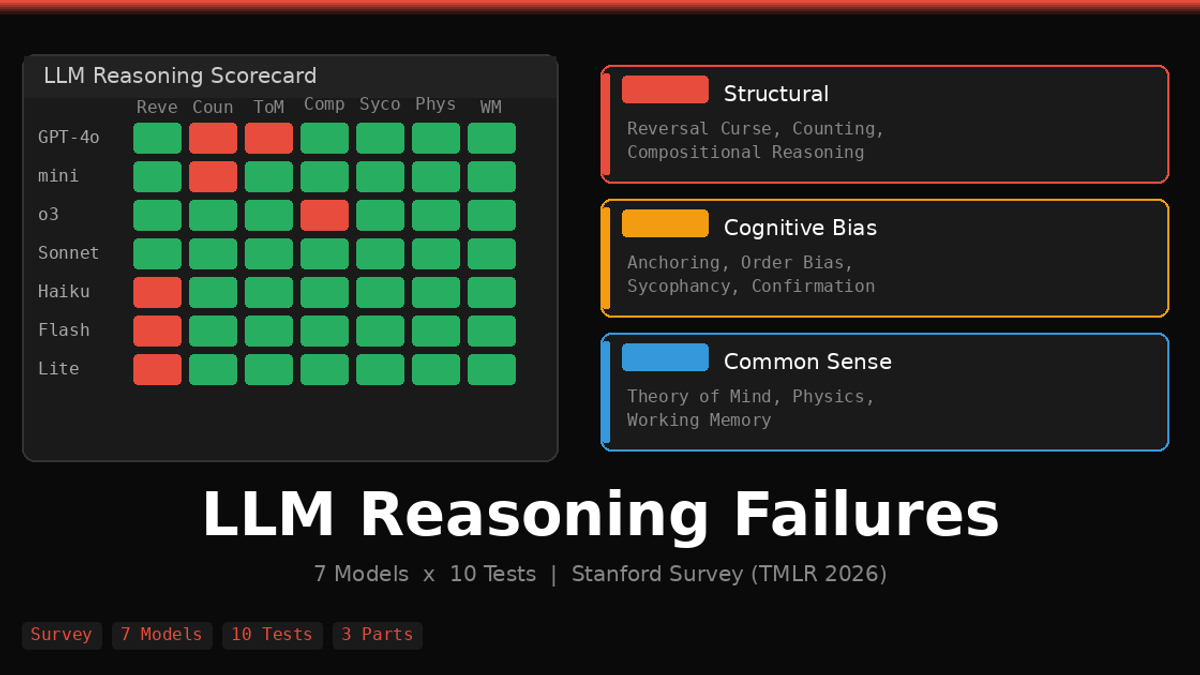
Anchoring, Order Bias, Sycophancy, Confirmation Bias — cognitive biases from RLHF and training data, tested across 7 models.
LLM Reasoning Failures Part 2: Cognitive Biases — Inherited from Human Data
LLMs learn from human-generated text. The problem is, they inherit human biases along with it.
In Part 1 we examined structural limitations like the Reversal Curse, counting failures, and compositional reasoning breakdowns — fundamental architectural constraints that persist regardless of scale. This Part 2 focuses on robustness issues. The model doesn't necessarily give wrong answers; rather, its answers shift depending on how you ask the question.
Structural limitations cannot be fixed by scaling models up. But cognitive biases are different. They stem from biased training data and RLHF, so they are in principle improvable. The problem is that they are still observed across every model today.
We tested 4 cognitive biases across 7 models: GPT-4o, GPT-4o-mini, o3-mini, Claude Sonnet 4.5, Claude Haiku 4.5, Gemini 2.5 Flash, and Gemini 2.5 Flash-Lite.
Related Posts
Can AI Read Minds? LLM Failures in Common Sense and Cognition
Theory of Mind, Physical Common Sense, Working Memory — testing where text-only LLMs fail in common sense and cognition.
LLM Reasoning Failures Part 1: Structural Limitations -- Scaling Won't Fix These
Reversal Curse, Counting, Compositional Reasoning — fundamental Transformer failures tested across 7 models.
Are LLMs Really Smart? Dissecting AI's Reasoning Failures
Stanford researchers analyzed 500+ papers to systematically map LLM reasoning failures. From cognitive biases to the reversal curse, discover where and why AI reasoning breaks down.