Rectified Flow: 1-Step 생성을 향한 경로 직선화
Flow Matching도 느리다면? Reflow로 경로를 펴서 1-step 생성까지. Stable Diffusion 3와 FLUX의 핵심 기술.
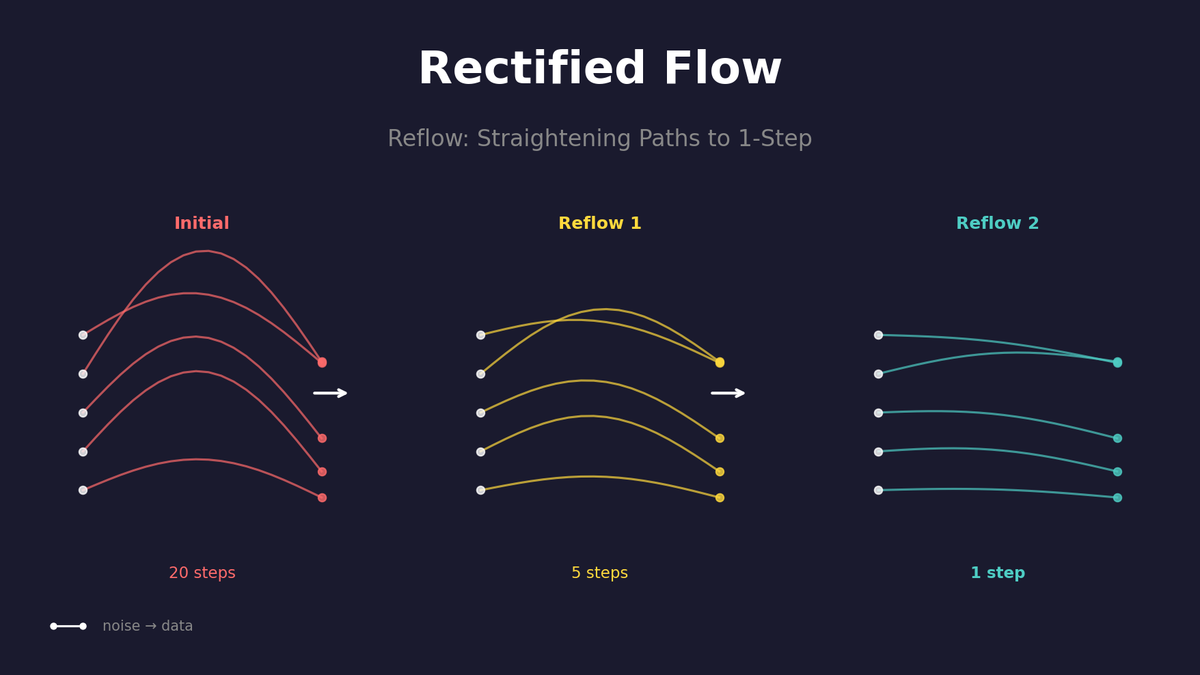
Rectified Flow: 1-Step 생성을 향한 경로 직선화
Flow Matching도 느리다면? Reflow로 경로를 펴서 1-step 생성까지 도달하는 방법.
TL;DR
- Rectified Flow: Flow Matching의 경로를 반복적으로 "직선화"하는 기법
- Reflow: 학습된 모델로 (noise, data) 쌍을 생성하고, 이 쌍으로 더 직선적인 경로를 재학습
- 핵심 이점: Reflow를 반복할수록 경로가 직선에 가까워지고, 최종적으로 1-step 생성 가능
- 실제 적용: Stable Diffusion 3, FLUX가 Rectified Flow 기반
1. 왜 Flow Matching만으로는 부족한가?
Flow Matching은 DDPM보다 훨씬 적은 스텝(10-50)으로 생성이 가능합니다. 하지만 여전히 한계가 있습니다.
Flow Matching의 한계
Flow Matching의 목표 속도장은:
이론적으로는 상수 속도장이지만, 실제 학습에서는 marginal velocity field를 학습합니다:
문제는 서로 다른 쌍들이 같은 를 지나갈 수 있다는 것입니다. 이 경로들이 교차(crossing)하면, 학습된 속도장은 이들의 평균이 되어 실제로는 곡선을 따라가게 됩니다.
경로 교차 문제
두 데이터 포인트 와 두 노이즈 가 있을 때:
어떤 에서 가 되면, 신경망은 두 방향의 평균을 예측하게 됩니다. 이것이 transport cost를 증가시키고 샘플링 스텝을 늘려야 하는 원인입니다.
2. Rectified Flow의 핵심 아이디어
Rectified Flow는 간단하지만 강력한 아이디어입니다:
**"학습된 flow로 (z, x₀) 쌍을 만들고, 이 쌍으로 다시 직선 경로를 학습하면 경로가 펴진다"**
Reflow 절차
- 초기 Flow Matching 학습: 랜덤 쌍으로 기본 모델 학습
- Coupling 생성: 학습된 모델로 noise 에서 시작해 data 를 생성
- 이제 는 실제로 flow를 따라 연결된 쌍
- Reflow 학습: 새로운 모델 을 쌍의 직선 경로로 학습
- 반복: 2-3을 반복할수록 경로가 더 직선화
수학적 표현
번째 reflow 후의 coupling을 라 하면:
여기서 이고, 는 번째 모델이 생성한 coupling입니다.
3. 왜 Reflow가 경로를 직선화하는가?
직관적 이해
처음에는 랜덤 coupling 를 사용합니다. 이 경로들은 서로 교차할 수 있습니다.
하지만 학습된 flow 을 따라가면:
- 에서 출발한 경로는 특정 에 도착
- 이 쌍은 이미 flow를 따라 연결되어 있음
- 따라서 이 쌍들의 직선 경로는 덜 교차함
Transport Cost 감소
Reflow의 핵심은 transport cost를 줄이는 것입니다:
Reflow를 반복하면:
경로가 직선화되면서 transport cost가 감소합니다.
이론적 보장
논문에서 증명된 중요한 성질:
- Causality: Reflow된 coupling은 인과적(causal)입니다. 즉, 가 주어지면 가 결정됨
- Straightness: Reflow를 무한히 반복하면 경로가 완전히 직선이 됨
- 1-step 가능성: 완전히 직선화되면 Euler 1-step으로 정확한 샘플링 가능
4. 1-Step Distillation
Reflow만으로도 경로가 직선화되지만, 실용적으로 1-step 생성을 위해서는 distillation이 필요합니다.
Progressive Distillation
스텝 수를 점진적으로 줄이는 방법:
- Teacher 모델: N steps
- Student 모델: N/2 steps로 teacher 출력 모방
- 반복하여 1-step까지 도달
Direct Distillation
Rectified Flow의 장점은 경로가 이미 직선에 가깝기 때문에 직접 1-step distillation이 가능하다는 것:
여기서 은 에서의 속도 예측입니다.
5. 구현
Reflow 학습
class RectifiedFlow:
    def __init__(self, model):
        self.model = model

    def loss(self, x0, z):
        """Reflow loss with fixed coupling."""
        t = torch.rand(x0.shape[0], device=x0.device)

        # Linear interpolation
        x_t = (1 - t[:, None]) * x0 + t[:, None] * z

        # Target velocity (straight line)
        v_target = z - x0

        # Predicted velocity
        v_pred = self.model(x_t, t)

        return F.mse_loss(v_pred, v_target)

    @torch.no_grad()
    def sample(self, z, n_steps=1):
        """Sample with Euler method."""
        x = z
        dt = 1.0 / n_steps

        for i in range(n_steps):
            t = 1.0 - i * dt
            t_batch = torch.full((x.shape[0],), t, device=x.device)
            v = self.model(x, t_batch)
            x = x - v * dt

        return x

    @torch.no_grad()
    def generate_coupling(self, z, n_steps=50):
        """Generate (z, x0) coupling pairs."""
        x0 = self.sample(z, n_steps=n_steps)
        return z, x0
Reflow 학습 루프
def train_reflow(data, n_reflows=3, n_epochs=500):
    """Train with multiple reflow iterations."""

    # Initial Flow Matching
    model = create_model()
    rf = RectifiedFlow(model)

    # Train on random coupling
    for epoch in range(n_epochs):
        x0 = sample_data(data)
        z = torch.randn_like(x0)
        loss = rf.loss(x0, z)
        loss.backward()
        optimizer.step()

    # Reflow iterations
    for k in range(n_reflows):
        print(f"Reflow {k+1}")

        # Generate coupling from current model
        z_all = torch.randn(len(data), dim)
        z_all, x0_all = rf.generate_coupling(z_all, n_steps=50)

        # Train new model on this coupling
        new_model = create_model()
        new_rf = RectifiedFlow(new_model)

        for epoch in range(n_epochs):
            idx = torch.randperm(len(x0_all))[:batch_size]
            loss = new_rf.loss(x0_all[idx], z_all[idx])
            loss.backward()
            optimizer.step()

        rf = new_rf

    return rf
1-Step Distillation
def distill_to_one_step(teacher_rf, student_model, data, n_epochs=1000):
    """Distill to 1-step generator."""
    optimizer = torch.optim.Adam(student_model.parameters(), lr=1e-4)

    for epoch in range(n_epochs):
        z = torch.randn(batch_size, dim)

        # Teacher generates target
        with torch.no_grad():
            x0_teacher = teacher_rf.sample(z, n_steps=10)

        # Student predicts in 1 step
        # x0 = z - v(z, t=1)
        v_pred = student_model(z, torch.ones(batch_size))
        x0_student = z - v_pred

        loss = F.mse_loss(x0_student, x0_teacher)

        optimizer.zero_grad()
        loss.backward()
        optimizer.step()

    return student_model
6. Stable Diffusion 3와 FLUX
SD3의 Rectified Flow 적용
Stable Diffusion 3는 Rectified Flow를 채택했습니다:
- MMDiT 아키텍처: 텍스트와 이미지를 동시에 처리하는 Multimodal DiT
- Rectified Flow: 기존 DDPM 대신 직선 경로 학습
- 결과: 동일 품질에서 더 적은 스텝 필요
FLUX의 발전
FLUX (by Black Forest Labs)는 SD3를 더 발전시켰습니다:
- Guidance Distillation: CFG를 모델에 내재화
- 더 적은 스텝: 4-8 스텝으로 고품질 생성
- FLUX.1-schnell: 1-4 스텝 생성 가능한 distilled 버전
왜 Rectified Flow인가?
기존 Stable Diffusion (DDPM 기반)에서 전환한 이유:
| 특성 | DDPM/DDIM | Rectified Flow |
|---|---|---|
| 이론적 기반 | Score matching | Optimal transport |
| 경로 | 곡선 | 직선 (또는 직선에 가까움) |
| 최소 스텝 | ~20-50 | ~4-10 (distill 후 1) |
| Distillation | 어려움 | 상대적으로 쉬움 |
7. Reflow 횟수와 품질
몇 번의 Reflow가 필요한가?
실험적으로:
- 1-Reflow: 상당한 직선화, 10-step으로 좋은 품질
- 2-Reflow: 더 직선화, 5-step 가능
- 3-Reflow: 거의 직선, 1-2 step 가능
하지만 reflow를 많이 할수록:
- 학습 시간 증가
- Coupling 생성에 시간 소요
- 수렴 속도 감소 가능
실용적 선택
대부분의 경우 1-2회 reflow + distillation이 가장 효율적입니다.
8. 한계와 주의사항
Coupling 품질 의존성
Reflow는 이전 모델의 생성 품질에 의존합니다:
- 초기 모델이 나쁘면 → 나쁜 coupling → 나쁜 reflow 결과
- 해결책: 초기 Flow Matching을 충분히 학습
Mode Collapse 위험
Reflow를 너무 많이 하면:
- Coupling이 특정 모드에 집중될 수 있음
- 다양성(diversity) 감소 가능
- 해결책: 적절한 reflow 횟수 선택, regularization
계산 비용
각 reflow 단계마다:
- 전체 데이터셋에 대해 coupling 생성 필요
- 새 모델 학습 필요
- 총 비용 = (1 + n_reflows) × 기본 학습 비용
결론
| 방법 | 스텝 수 | 특징 |
|---|---|---|
| DDPM | 1000 | 원본, 느림 |
| DDIM | 50-100 | 결정론적 샘플링 |
| Flow Matching | 10-50 | 직선 경로 학습 |
| Rectified Flow | 5-10 | Reflow로 경로 직선화 |
| Rectified + Distill | 1-4 | 1-step 생성 가능 |
Rectified Flow는 "경로를 펴면 빨라진다"는 직관적 아이디어를 실현한 방법입니다. Stable Diffusion 3와 FLUX의 성공이 이 접근법의 실용성을 증명했습니다.
References
- Liu, X., et al. "Flow Straight and Fast: Learning to Generate and Transfer Data with Rectified Flow" (ICLR 2023)
- Esser, P., et al. "Scaling Rectified Flow Transformers for High-Resolution Image Synthesis" (Stable Diffusion 3, 2024)
- Lipman, Y., et al. "Flow Matching for Generative Modeling" (ICLR 2023)
- Salimans, T. & Ho, J. "Progressive Distillation for Fast Sampling of Diffusion Models" (ICLR 2022)
이메일로 받아보기
관련 포스트
SDFT: 자기 증류로 망각 없이 학습하기
복잡한 강화학습 없이, 모델이 스스로를 선생님 삼아 새로운 기술을 배우면서도 기존 능력을 유지하는 방법.
Qwen3-Max-Thinking 스냅샷 공개: 추론형 AI의 새로운 기준
최근 LLM 시장의 트렌드는 단순히 '더 많은 데이터'를 학습하는 것을 넘어, 모델이 '어떻게 생각하느냐'에 집중하고 있습니다. 알리바바 클라우드(Alibaba Cloud)가 자사의 가장 강력한 모델 Qwen3-Max-Thinking의 API 스냅샷(qwen3-max-2026-01-23)을 공개했습니다.
YOLO26: Upgrade or Hype? 완벽 가이드
2026년 1월 출시된 YOLO26의 핵심 기능, YOLO11과의 성능 비교, 그리고 실제 업그레이드 가치가 있는지 실습과 함께 분석합니다.