Claude Sonnet 4.6: Opus-Level Performance, 40% Cheaper — Benchmark Deep Dive
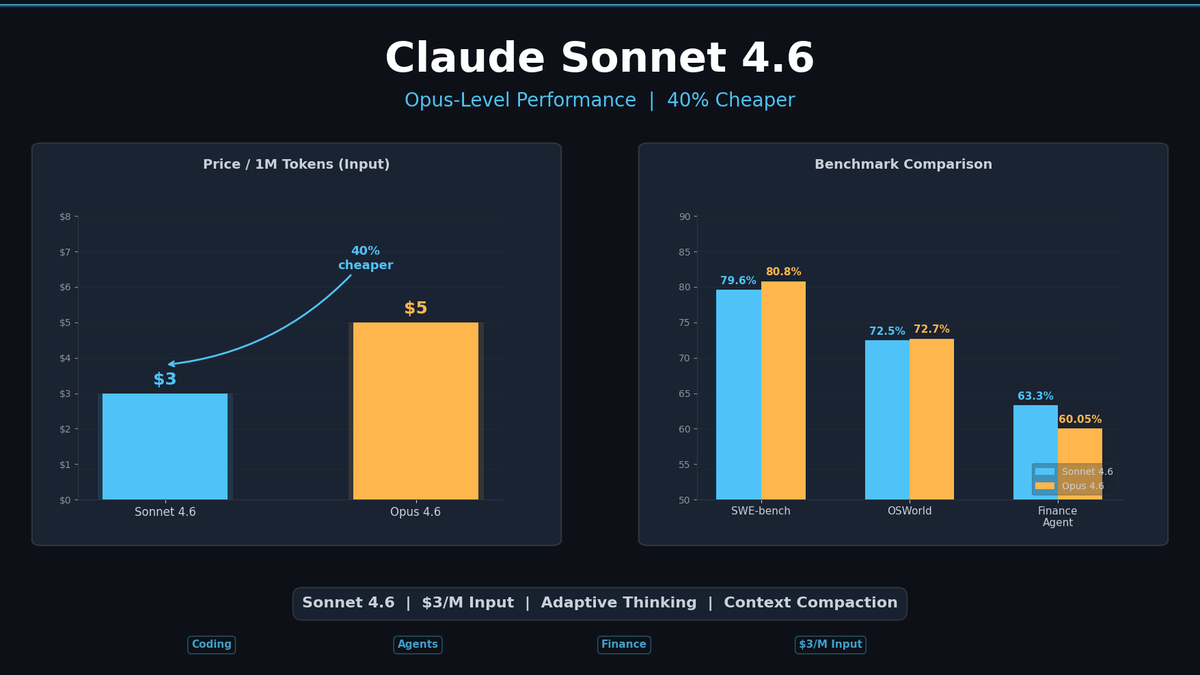
Claude Sonnet 4.6 scores 79.6% on SWE-bench, 72.5% on OSWorld, and 1633 Elo on GDPval-AA — matching or beating Opus 4.6 on production tasks. $3/$15 vs $5/$25 per M tokens. Analysis of Adaptive Thinking, Context Compaction, and OSWorld growth trajectory.
Did Sonnet Just Beat Opus? — Claude Sonnet 4.6 Benchmark Deep Dive
Anthropic released Claude Sonnet 4.6 on February 17, and it outperforms the flagship Opus 4.6 on several key benchmarks. At roughly 40% less cost. The secret isn't a "cheaper knock-off" — it's architectural-level structural changes.
Opus vs Sonnet: What Changed?
The old Opus-Sonnet dynamic was straightforward. Opus was the full-spec brain; Sonnet was the compressed version. Same architecture, smaller size, naturally lower performance.
In the 4.6 generation, that formula breaks.
Related Posts
MiniMax M2.5: Opus-Level Performance at $1 per Hour
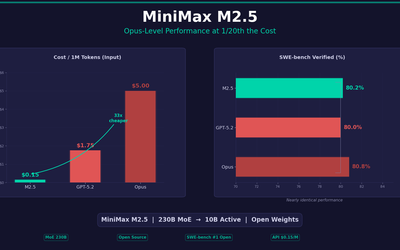
MiniMax M2.5 achieves SWE-bench 80.2% using only 10B active parameters from a 230B MoE architecture. 1/20th the cost of Claude Opus with comparable coding performance. Forge RL framework, benchmark analysis, pricing comparison.
Backpropagation From Scratch: Chain Rule, Computation Graphs, and Topological Sort
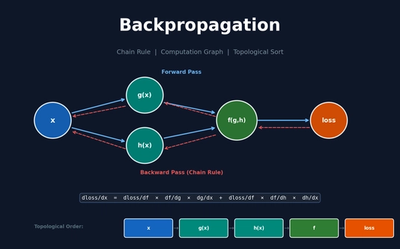
How microgpt.py's 15-line backward() works. From high school calculus to chain rule, computation graphs, topological sort, and backpropagation.
Karpathy's microgpt.py Dissected: Understanding GPT's Essence in 150 Lines
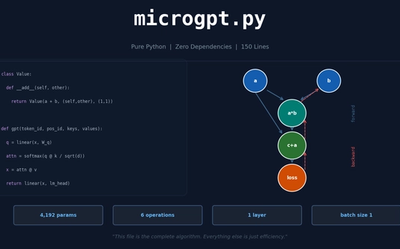
A line-by-line dissection of microgpt.py -- a pure Python GPT implementation with zero dependencies. Training, inference, and autograd in 150 lines.