TransformerLens in Practice: Reading Model Circuits with Activation Patching
Using TransformerLens to directly manipulate model activations, we trace which layers and heads causally produce the answer. A hands-on guide to activation patching.
TransformerLens in Practice: Reading Model Circuits with Activation Patching
In the previous post, we treated Lens as a window into the model's intermediate thoughts.
But "reading" alone cannot answer the most important question:
Does the model actually *use* this information?
Just because a hidden state at some layer contains "Paris" does not mean that layer causally contributes to the final answer. Information can be present but unused. A layer might hold the right answer in its representation, yet the model might arrive at its output through entirely different pathways.
Related Posts

SAE and TensorLens: The Age of Feature Interpretability
Individual neurons are uninterpretable. Sparse Autoencoders extract monosemantic features from model internals, and TensorLens analyzes the entire Transformer as a single unified tensor.
From Logit Lens to Tuned Lens: Reading the Intermediate Thoughts of Transformers
What happens inside an LLM between input and output? Logit Lens and Tuned Lens let us observe how Transformers build predictions layer by layer.
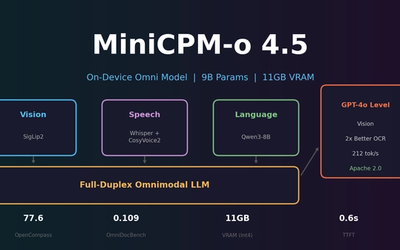
We Benchmarked MiniCPM-o 4.5 in Korean. Here's What Actually Happens.
We benchmarked MiniCPM-o 4.5's Korean performance side by side with English. Image descriptions, OCR, document extraction — what works, what breaks, and why the root cause is architecture, not prompts.