On-Device GPT-4o Has Arrived? A Deep Dive into MiniCPM-o 4.5
OpenBMB's MiniCPM-o 4.5 achieves GPT-4o-level vision performance with just 9B parameters, running on only 11GB VRAM with Int4 quantization. A deep analysis of the architecture, benchmarks, and practical deployment guide.
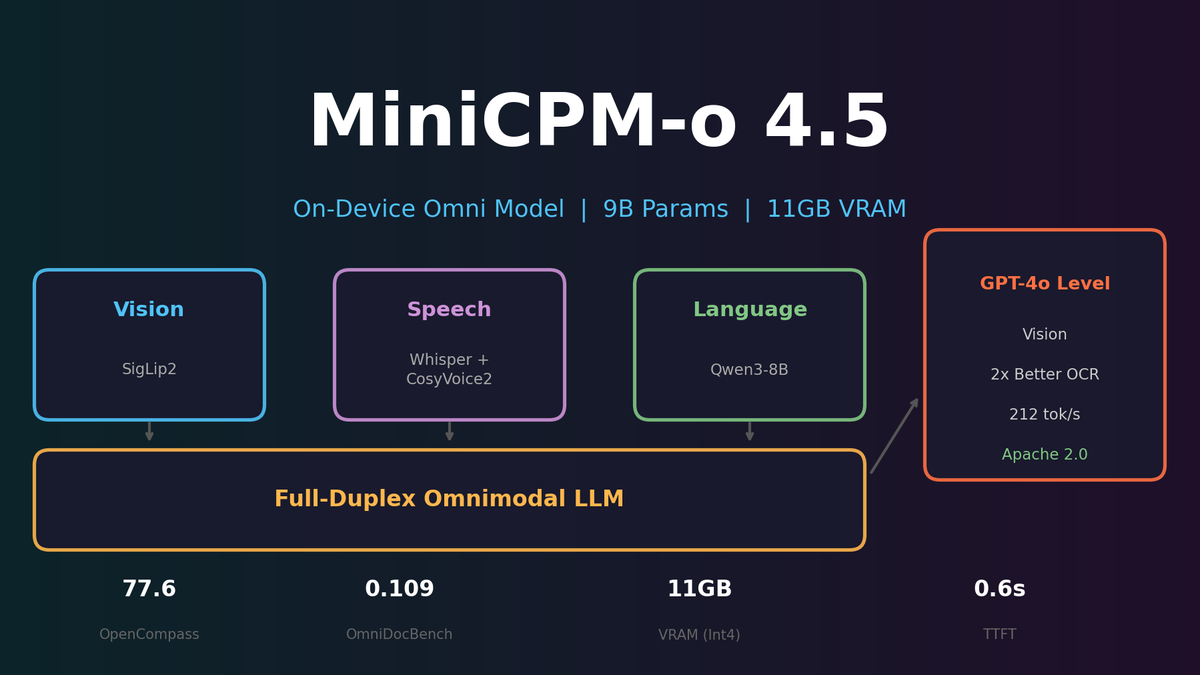
On-Device GPT-4o Has Arrived? A Deep Dive into MiniCPM-o 4.5
When using AI models, we always face trade-offs. Want performance? You need massive GPU clusters. Want on-device? Sacrifice performance. But recently, a model has appeared that breaks this formula entirely.
MiniCPM-o 4.5 from OpenBMB achieves GPT-4o-level vision performance with just 9B parameters, while running on only 11GB VRAM with Int4 quantization. It processes text, images, and speech in a single model — a true Omni model.
In this article, we go beyond a simple introduction. We'll explore why MiniCPM-o's architecture is so efficient, what those benchmark numbers actually mean in practice, and how you can leverage it in your own projects.
The Current State of Multimodal AI: Why Omni Models?
Related Posts
We Benchmarked MiniCPM-o 4.5 in Korean. Here's What Actually Happens.
We benchmarked MiniCPM-o 4.5's Korean performance side by side with English. Image descriptions, OCR, document extraction — what works, what breaks, and why the root cause is architecture, not prompts.
Why GPT-4o Is So Fast: The Critical Difference Between Multimodal and Omni Models
A token-level analysis comparing the pipeline approach (STT→LLM→TTS) text bottleneck with native omni model token fusion. Explains why GPT-4o and MiniCPM-o are fundamentally faster.
PaperBanana: AI Now Generates Publication-Quality Academic Illustrations
PaperBanana from Google and Peking University is an agentic system that automatically generates publication-ready academic illustrations from paper text.