Why GPT-4o Is So Fast: The Critical Difference Between Multimodal and Omni Models
A token-level analysis comparing the pipeline approach (STT→LLM→TTS) text bottleneck with native omni model token fusion. Explains why GPT-4o and MiniCPM-o are fundamentally faster.
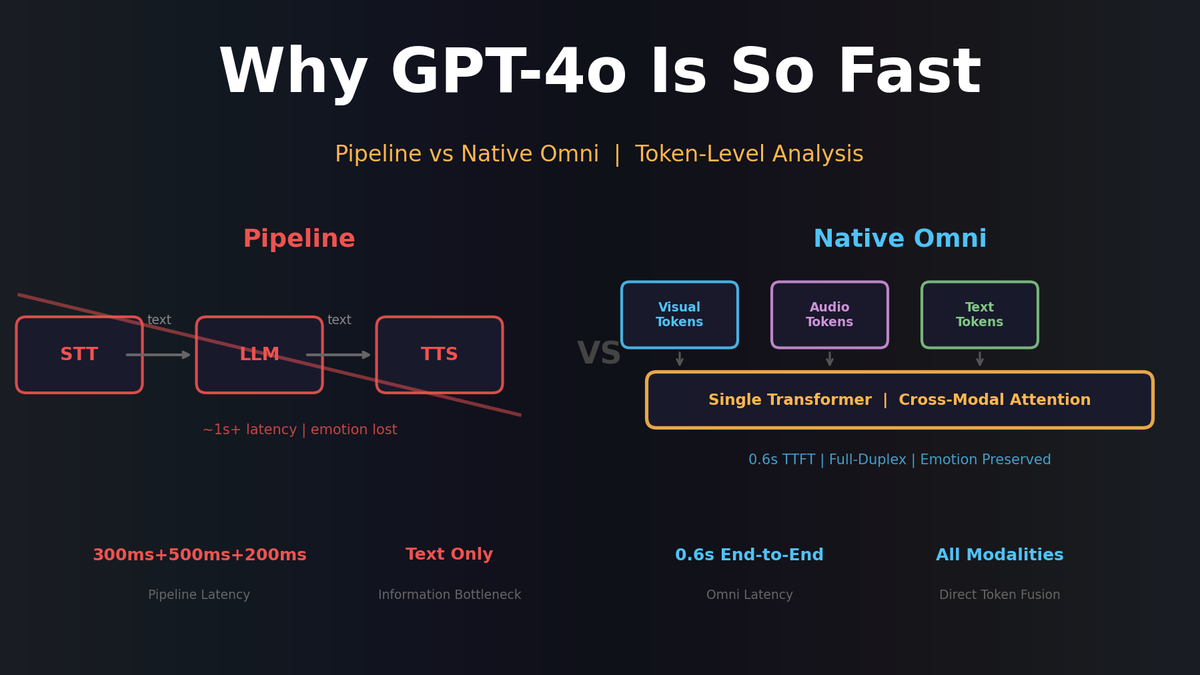
Why GPT-4o Is So Fast: The Critical Difference Between Multimodal and Omni Models
When GPT-4o launched, what surprised most people wasn't its performance. It was the speed. Ask it something by voice, and it responds in near real-time with emotion in its voice. It felt fundamentally different from every voice AI before it.
And then MiniCPM-o 4.5 matched that GPT-4o-level performance with just 9B parameters. How?
The answer lies in the "Omni architecture." More precisely, it comes down to how different modalities of data are tokenized and mixed inside a single model.
In this article, we dissect the difference between the pipeline approach and the native Omni approach at the token level.
Related Posts
We Benchmarked MiniCPM-o 4.5 in Korean. Here's What Actually Happens.
We benchmarked MiniCPM-o 4.5's Korean performance side by side with English. Image descriptions, OCR, document extraction — what works, what breaks, and why the root cause is architecture, not prompts.
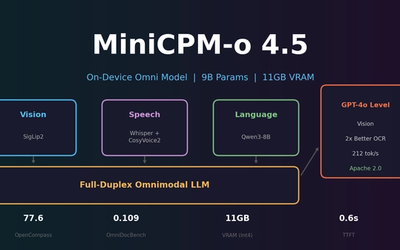
On-Device GPT-4o Has Arrived? A Deep Dive into MiniCPM-o 4.5
OpenBMB's MiniCPM-o 4.5 achieves GPT-4o-level vision performance with just 9B parameters, running on only 11GB VRAM with Int4 quantization. A deep analysis of the architecture, benchmarks, and practical deployment guide.
PaperBanana: AI Now Generates Publication-Quality Academic Illustrations
PaperBanana from Google and Peking University is an agentic system that automatically generates publication-ready academic illustrations from paper text.