RAG Evaluation: Beyond Precision/Recall
"How do I know if my RAG is working?" — Precision/Recall aren't enough. You need to measure Faithfulness, Relevance, and Context Recall to see the real quality.
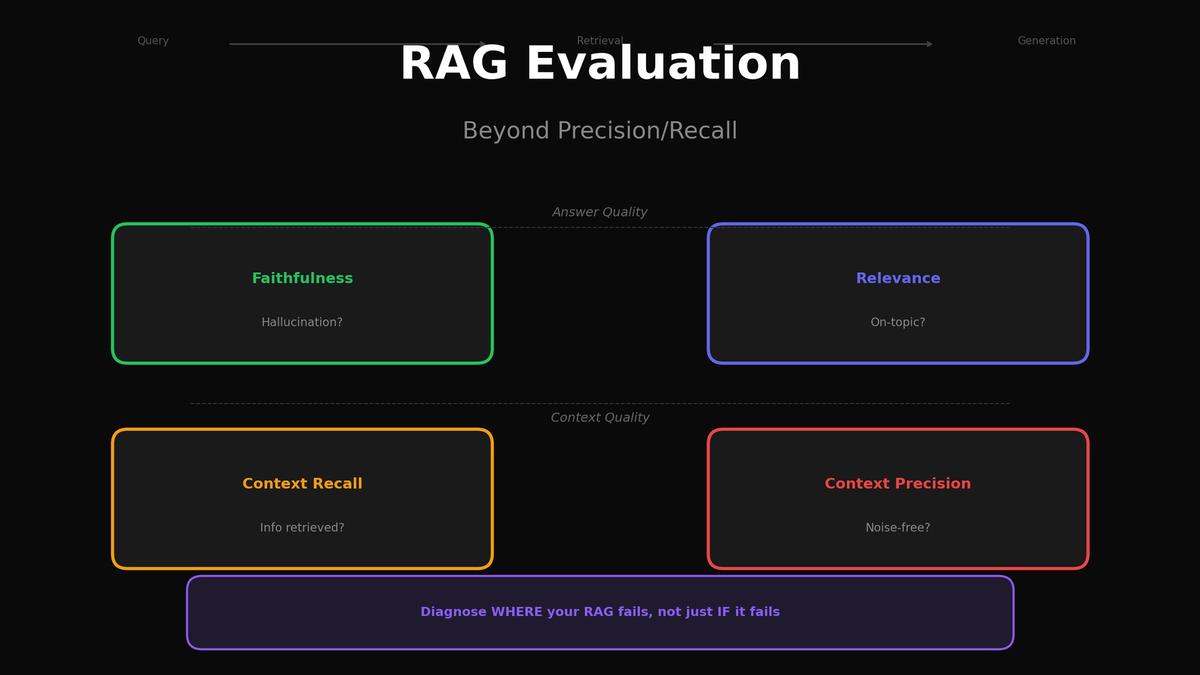
RAG Evaluation: Beyond Precision/Recall
"How do I know if my RAG is working?" — Precision/Recall aren't enough. You need to measure Faithfulness, Relevance, and Context Recall to see the real quality.
Why Traditional Metrics Fall Short
Traditional IR (Information Retrieval) metrics:
| Metric | Measures | Limitation in RAG |
|---|---|---|
| **Precision@K** | Relevant docs in top K | May not correlate with answer quality |
| **Recall@K** | Retrieved relevant docs / all relevant | Requires ground truth, often impractical |
| **MRR** | Rank of first relevant doc | Meaningless when multiple docs needed |
Problem: Can't distinguish between good retrieval with bad answer, or mediocre retrieval with good answer.
Case 1: Good Retrieval, Bad Answer — 3 relevant documents retrieved (High Precision), but LLM distorts content in answer (Hallucination)
Case 2: Mediocre Retrieval, Good Answer — Only 1 relevant document retrieved (Low Precision), but that document enabled accurate answer
The Three Axes of RAG Evaluation
RAG systems should be evaluated on three axes:
Query → Retrieval → Generation
- Retrieval stage → Context Quality (Context Recall, Context Precision)
- Generation stage → Answer Quality (Faithfulness, Answer Relevance)
1. Context Quality
How well do retrieved documents match the question?
- Context Recall: Was necessary information retrieved?
- Context Precision: What fraction of retrieved docs are actually useful?
2. Answer Quality
How good is the generated answer?
- Faithfulness: Is the answer grounded in retrieved documents? (Hallucination check)
- Answer Relevance: Does the answer address the question?
3. End-to-End Quality
Final quality of the entire pipeline
- Answer Correctness: Is the answer actually correct? (Requires ground truth)
Core Metrics Deep Dive
1. Faithfulness
Are all claims in the answer supported by retrieved documents?
def compute_faithfulness(answer: str, contexts: List[str]) -> float:
    """
    1. Extract individual claims from answer
    2. Check if each claim is supported by context
    3. Return ratio of supported claims
    """
    claims = extract_claims(answer)
    supported = 0

    for claim in claims:
        if is_supported_by_context(claim, contexts):
            supported += 1

return supported / len(claims) if claims else 0Example:
Context: "Tesla cut prices by up to 20% on January 13, 2023."
Answer: "Tesla cut prices by 20% in January 2023, which caused competitors to lower their prices too."
Claims:
- "Tesla cut prices in January 2023" → Supported ✓
- "Prices cut by 20%" → Supported ✓
- "Competitors lowered prices" → Not in context ✗
Faithfulness = 2/3 = 0.67
Why it matters: Low Faithfulness = Hallucination risk
2. Answer Relevance
Does the answer actually answer the question?
def compute_answer_relevance(question: str, answer: str) -> float:
    """
    1. Generate questions from the answer
    2. Measure similarity between original and generated questions
    """
    # Guess the question from just the answer
    generated_questions = generate_questions_from_answer(answer, n=3)

    # Similarity to original question
    similarities = [
        semantic_similarity(question, gen_q)
        for gen_q in generated_questions
    ]

return np.mean(similarities)Example:
Question: "Who is Tesla's CEO?"
Answer: "Tesla is an electric vehicle company."
Generated Questions from Answer:
- "What kind of company is Tesla?"
- "What are electric vehicle companies?"
Low similarity to original → Low Answer Relevance
Why it matters: Detects when LLM ignored the question or gave tangential answer
3. Context Recall
Is the information needed for the answer present in retrieved documents?
def compute_context_recall(
    ground_truth: str,
    contexts: List[str]
) -> float:
    """
    1. Extract key statements from ground truth
    2. Check if each statement is supported by context
    """
    gt_statements = extract_statements(ground_truth)
    attributed = 0

    for statement in gt_statements:
        if any(supports(ctx, statement) for ctx in contexts):
            attributed += 1

return attributed / len(gt_statements) if gt_statements else 0Example:
Ground Truth: "Sam Altman was fired on November 17, 2023, and returned on November 22."
Contexts Retrieved:
- [1] "Sam Altman fired from OpenAI (2023-11-17)"
- [2] "Microsoft CEO expressed support for Sam Altman"
Ground Truth Statements:
- "Sam Altman fired 2023-11-17" → Supported by Context 1 ✓
- "Sam Altman returned 2023-11-22" → Not found ✗
Context Recall = 1/2 = 0.5
Why it matters: Directly measures retrieval failure (missing necessary docs)
4. Context Precision
What fraction of retrieved documents actually contributed to the answer?
def compute_context_precision(
    question: str,
    answer: str,
    contexts: List[str]
) -> float:
    """
    Check if each retrieved context contributed to the answer
    """
    useful = 0

    for ctx in contexts:
        if contributes_to_answer(ctx, question, answer):
            useful += 1

    return useful / len(contexts) if contexts else 0
Why it matters: Too much noise confuses the LLM → degrades answer quality
Relationship Between Metrics
Question → Context Quality (Recall, Precision) → Answer Quality (Faithfulness, Relevance) → Answer Correctness
| Situation | Context Recall | Faithfulness | Diagnosis |
|---|---|---|---|
| Retrieval failure | Low | High | Improve retrieval |
| Hallucination | High | Low | Improve prompt/model |
| Both low | Low | Low | Check entire pipeline |
| Ideal | High | High | Working correctly |
Practical Implementation: Using RAGAS
RAGAS is a framework for RAG evaluation that computes these metrics easily.
Installation and Basic Usage
# pip install ragas

from ragas import evaluate
from ragas.metrics import (
    faithfulness,
    answer_relevancy,
    context_recall,
    context_precision,
)
from datasets import Dataset

# Prepare evaluation data
eval_data = {
    "question": ["Who is Tesla's CEO?"],
    "answer": ["Elon Musk is Tesla's CEO."],
    "contexts": [["Elon Musk is Tesla's CEO and founder."]],
    "ground_truth": ["Elon Musk"]  # Needed for Context Recall
}

dataset = Dataset.from_dict(eval_data)

# Run evaluation
results = evaluate(
    dataset,
    metrics=[
        faithfulness,
        answer_relevancy,
        context_recall,
        context_precision,
    ]
)

print(results)
Batch Evaluation
def evaluate_rag_batch(
    questions: List[str],
    rag_system,
    ground_truths: List[str] = None
) -> pd.DataFrame:
    """Evaluate RAG system on multiple questions"""

    results = []
    for i, question in enumerate(questions):
        # Run RAG
        answer, contexts = rag_system.query(question)

        # Evaluate
        result = {
            "question": question,
            "answer": answer,
            "faithfulness": compute_faithfulness(answer, contexts),
            "relevance": compute_answer_relevance(question, answer),
            "context_precision": compute_context_precision(
                question, answer, contexts
            ),
        }

        if ground_truths:
            result["context_recall"] = compute_context_recall(
                ground_truths[i], contexts
            )

        results.append(result)

    return pd.DataFrame(results)
Evaluation Without Ground Truth: LLM-as-Judge
When ground truth is unavailable, use an LLM as evaluator.
Faithfulness Evaluation
FAITHFULNESS_PROMPT = """
Given the context and answer, determine if each claim in the answer
is supported by the context.

Context:
{context}

Answer:
{answer}

For each claim in the answer, respond with:
- Claim: [the claim]
- Verdict: [Supported/Not Supported]
- Evidence: [quote from context if supported]

Finally, provide the overall faithfulness score (0-1).
"""

def llm_faithfulness(answer: str, context: str, llm) -> float:
    prompt = FAITHFULNESS_PROMPT.format(context=context, answer=answer)
    response = llm.generate(prompt)
    return parse_faithfulness_score(response)
Answer Relevance Evaluation
RELEVANCE_PROMPT = """
Given the question and answer, rate how relevant the answer is
to the question on a scale of 0-1.

Question: {question}
Answer: {answer}

Consider:
- Does the answer address the question directly?
- Is the answer complete?
- Is there irrelevant information?

Score (0-1):
Reasoning:
"""

def llm_relevance(question: str, answer: str, llm) -> float:
    prompt = RELEVANCE_PROMPT.format(question=question, answer=answer)
    response = llm.generate(prompt)
    return parse_relevance_score(response)
Evaluation Strategy: When to Measure What
Metrics by Development Stage
| Stage | Primary Metrics | Purpose |
|---|---|---|
| **Prototype** | Faithfulness, Relevance | Quick feedback |
| **Retrieval Tuning** | Context Recall, Precision | Improve retrieval |
| **Prompt Tuning** | Faithfulness | Reduce hallucination |
| **Production** | All + Latency | Comprehensive monitoring |
Evaluation Set Design
# Include diverse question types
eval_set = {
    "simple": [  # Single doc sufficient
        "Who is Tesla's CEO?",
        "When was OpenAI founded?",
    ],
    "multi_hop": [  # Multiple docs needed
        "What did Microsoft's CEO say when OpenAI's CEO was fired?",
    ],
    "temporal": [  # Time reasoning required
        "Who was CEO before Sam Altman returned?",
    ],
    "comparison": [  # Comparison questions
        "Which sold more in 2023, Tesla or BYD?",
    ],
    "unanswerable": [  # Cannot be answered
        "What are Tesla's 2025 sales figures?",
    ]
}
Automated Evaluation Pipeline
class RAGEvaluator:
    def __init__(self, rag_system, llm_judge):
        self.rag = rag_system
        self.judge = llm_judge
        self.metrics_history = []

    def evaluate(self, eval_set: Dict[str, List[str]]) -> Dict:
        results = {}

        for category, questions in eval_set.items():
            category_results = []

            for question in questions:
                answer, contexts = self.rag.query(question)

                metrics = {
                    "faithfulness": self.compute_faithfulness(answer, contexts),
                    "relevance": self.compute_relevance(question, answer),
                    "context_precision": self.compute_precision(
                        question, answer, contexts
                    ),
                }
                category_results.append(metrics)

            results[category] = {
                "avg_faithfulness": np.mean([r["faithfulness"] for r in category_results]),
                "avg_relevance": np.mean([r["relevance"] for r in category_results]),
                "avg_precision": np.mean([r["context_precision"] for r in category_results]),
            }

        self.metrics_history.append({
            "timestamp": datetime.now(),
            "results": results
        })

        return results

    def compare_versions(self, v1_results: Dict, v2_results: Dict) -> Dict:
        """Compare two versions of RAG system"""
        comparison = {}
        for category in v1_results:
            comparison[category] = {
                metric: v2_results[category][metric] - v1_results[category][metric]
                for metric in v1_results[category]
            }
        return comparison
Common Mistakes and Solutions
1. Ground Truth Dependency
Problem: Ground truth is too hard to create, so no evaluation happens
Solution: Faithfulness and Relevance don't require ground truth
2. Average Trap
Problem: Average Faithfulness is 0.8 but 0.3 on specific question types
Solution: Evaluate separately by question type
3. Metric Gaming
Problem: Making answers overly conservative to increase Faithfulness
Solution: Evaluate with Relevance too (detects too-short or tangential answers)
Conclusion
RAG evaluation must separately measure retrieval quality and answer quality.
Core Metrics:
- Context Quality — Context Recall (Was necessary info retrieved?), Context Precision (Was retrieval noise-free?)
- Answer Quality — Faithfulness (No hallucination?), Answer Relevance (Did it answer the question?)
Practical Recommendations:
- During development: Faithfulness + Relevance (quick feedback)
- Retrieval tuning: Context Recall (retrieval quality)
- Production: All metrics + per-category analysis
These four metrics let you diagnose exactly where your RAG system is failing.
Related Posts
Subscribe to Newsletter
Related Posts
Diffusion LLM Part 4: LLaDA 2.0 -> 2.1 -- Breaking 100B with MoE + Token Editing
MoE scaling, Token Editing (T2T+M2T), S-Mode/Q-Mode, RL Framework -- how LLaDA 2.X makes diffusion LLMs practical.
Diffusion LLM Part 3: LLaDA -- Building an 8B LLM with Masked Diffusion
Variable Masking, Fisher Consistency, In-Context Learning, Reversal Curse -- how LLaDA built a real LLM with diffusion.
Diffusion LLM Part 2: Discrete Diffusion -- How to Add Noise to Text
D3PM, Transition Matrices, Absorbing States, MDLM -- how to bring diffusion from continuous space to discrete tokens.