YOLO26: Upgrade or Hype? The Complete Guide
Analyzing YOLO26's key features released in January 2026, comparing performance with YOLO11, and determining if it's worth upgrading through hands-on examples.
title: "YOLO26: Upgrade or Hype? The Complete Guide"
description: "Analyzing YOLO26's key features released in January 2026, comparing performance with YOLO11, and determining if it's worth upgrading through hands-on examples."
YOLO26: Upgrade or Hype? The Complete Guide
On January 14, 2026, Ultralytics released a new YOLO model: YOLO26.
With the tagline "Built End-to-End. Built for Edge.", this model promises significant improvements. But is it a genuine upgrade or just marketing hype?
In this article, we'll analyze YOLO26's core technical changes, compare it with YOLO11 through actual code, and determine whether it's worth upgrading.
The Evolution of YOLO: From v1 to 26
YOLO (You Only Look Once) has been synonymous with real-time object detection since Joseph Redmon first published it in 2015.
| Version | Year | Key Features |
|---|---|---|
| YOLOv1 | 2015 | First single-pass object detection |
| YOLOv3 | 2018 | Multi-scale detection |
| YOLOv5 | 2020 | PyTorch-based, Ultralytics begins |
| YOLOv8 | 2023 | Anchor-free design |
| YOLO11 | 2024 | Efficiency optimization |
| **YOLO26** | **2026** | **NMS-Free, MuSGD, Edge optimization** |
YOLO26 Core Technical Changes
1. NMS-Free End-to-End Inference
Previous YOLO models required Non-Maximum Suppression (NMS) as a post-processing step to remove duplicate bounding boxes.
- Before: Image → Model Inference → NMS Post-processing → Final Result
- YOLO26: Image → Model Inference → Final Result (End-to-End)
YOLO26 handles NMS internally within the model, resulting in:
- Simplified pipeline
- Reduced latency
- Lower deployment complexity
2. DFL (Distribution Focal Loss) Removal
The DFL module introduced in YOLOv8 improved bounding box regression but caused compatibility issues on some hardware.
YOLO26 completely removes DFL while maintaining performance. This means:
- Simplified ONNX, TFLite exports
- Better edge device compatibility
- Reduced model complexity
3. MuSGD Optimizer: LLM Techniques in CV
The most interesting change is the MuSGD optimizer.
MuSGD = SGD + Muon (Hybrid)
Muon is an optimization technique inspired by Moonshot AI's Kimi K2 LLM training. YOLO26 applies this to computer vision:
- More stable training: Reduced hyperparameter tuning burden
- Faster convergence: Similar performance with fewer epochs
- Better generalization: SGD's robust generalization + Muon's adaptive properties
4. Enhanced Small Object Detection
YOLO26 introduces two techniques for better small object recognition:
- ProgLoss (Progressive Loss): Focus on easy objects early, difficult objects later in training
- STAL (Small-Target-Aware Label Assignment): Label assignment strategy optimized for small objects
Performance Benchmarks: YOLO26 by the Numbers
Detection (COCO val2017)
| Model | mAP50-95 | CPU (ms) | T4 TensorRT (ms) | Params (M) |
|---|---|---|---|---|
| YOLO26n | 40.9 | 38.9 | 1.4 | 2.4 |
| YOLO26s | 48.6 | 87.2 | 2.3 | 9.5 |
| YOLO26m | 53.1 | 220.0 | 5.0 | 20.4 |
| YOLO26l | 55.0 | 286.2 | 6.7 | 24.8 |
| YOLO26x | 57.5 | 525.8 | 11.3 | 55.7 |
YOLO11n vs YOLO26n Direct Comparison
| Metric | YOLO11n | YOLO26n | Change |
|---|---|---|---|
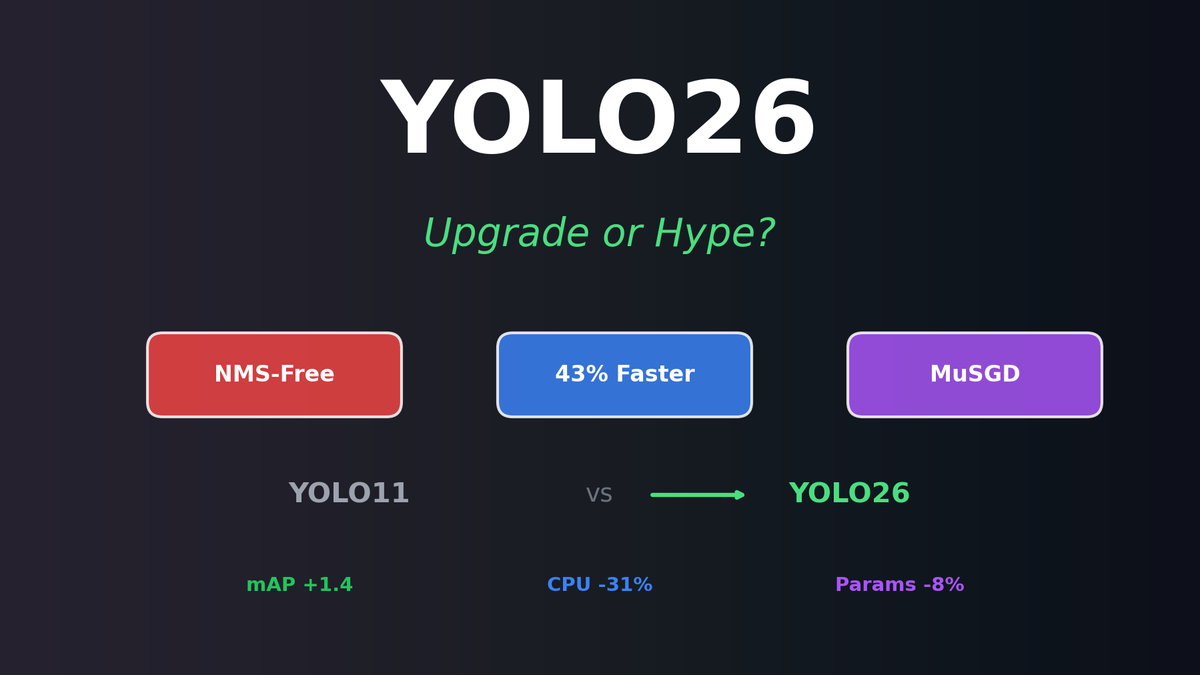
| mAP50-95 | 39.5 | 40.9 | **+1.4** |
| CPU Inference | 56.1ms | 38.9ms | **-31%** |
| Parameters | 2.6M | 2.4M | **-8%** |
Key Point: CPU inference speed improved by 31% while accuracy also increased.
Segmentation Performance
| Model | mAPbox | mAPmask | CPU (ms) |
|---|---|---|---|
| YOLO26n-seg | 39.6 | 33.9 | 52.8 |
| YOLO26x-seg | 56.5 | 47.0 | 682.5 |
Pose Estimation Performance
| Model | mAPpose | CPU (ms) |
|---|---|---|
| YOLO26n-pose | 51.0 | 45.2 |
| YOLO26x-pose | 70.9 | 601.6 |
Hands-On: Object Detection, Segmentation, and Pose Estimation with YOLO26
Setup
# Install latest Ultralytics
!pip install -U ultralytics

from ultralytics import YOLO
import matplotlib.pyplot as plt
from PIL import Image
Object Detection
# Load YOLO26 model
model = YOLO("yolo26n.pt")

# Inference
results = model("https://ultralytics.com/images/bus.jpg")

# Visualize results
for r in results:
    im_array = r.plot()
    im = Image.fromarray(im_array[..., ::-1])
    plt.imshow(im)
    plt.axis('off')
    plt.show()
Instance Segmentation
# Segmentation model
model_seg = YOLO("yolo26n-seg.pt")

results = model_seg("https://ultralytics.com/images/bus.jpg")

for r in results:
    im_array = r.plot()  # Includes masks
    plt.imshow(im_array[..., ::-1])
    plt.show()
Pose Estimation
# Pose model (17 keypoints)
model_pose = YOLO("yolo26n-pose.pt")

results = model_pose("https://ultralytics.com/images/zidane.jpg")

for r in results:
    im_array = r.plot()  # Shows skeleton
    plt.imshow(im_array[..., ::-1])
    plt.show()
Speed Comparison: YOLO11 vs YOLO26
import time
import numpy as np

model_11 = YOLO("yolo11n.pt")
model_26 = YOLO("yolo26n.pt")

test_image = "https://ultralytics.com/images/bus.jpg"

# Warmup
_ = model_11(test_image, verbose=False)
_ = model_26(test_image, verbose=False)

# Measure YOLO11
times_11 = []
for _ in range(10):
    start = time.time()
    _ = model_11(test_image, verbose=False)
    times_11.append(time.time() - start)

# Measure YOLO26
times_26 = []
for _ in range(10):
    start = time.time()
    _ = model_26(test_image, verbose=False)
    times_26.append(time.time() - start)

print(f"YOLO11n: {np.mean(times_11)*1000:.2f}ms")
print(f"YOLO26n: {np.mean(times_26)*1000:.2f}ms")
Model Export: The Real Benefit of DFL Removal
Thanks to YOLO26's DFL removal, exporting to various formats is much simpler:
model = YOLO("yolo26n.pt")

# ONNX (Web, general purpose)
model.export(format="onnx")

# TensorRT (NVIDIA GPU)
model.export(format="engine")

# TFLite (Mobile, Edge)
model.export(format="tflite")

# CoreML (iOS)
model.export(format="coreml")

# OpenVINO (Intel CPU/GPU)
model.export(format="openvino")
Conclusion: Upgrade or Hype?
✅ Recommended to Upgrade When
- Edge/IoT Deployment: 43% CPU inference improvement makes a real difference for battery and cost
- Starting New Projects: Starting with the latest 2026 model makes sense
- Complex Pipelines: NMS-Free simplifies deployment architecture
- Small Object Detection: Noticeable improvement in drone footage, satellite imagery
⚠️ No Rush to Switch When
- Stable Production Environment: If YOLO11 works well, stick with what's proven
- GPU-Centric Environment: Performance gap is relatively smaller on GPU
- Heavy Customization: If you have extensive YOLO11-based tuning
Final Verdict
It's not hype. YOLO26 delivers genuine technical improvements.
- NMS-Free architecture simplifies deployment
- MuSGD improves training stability
- CPU performance gains provide real value for edge computing
However, this doesn't mean "migrate all projects immediately." New projects should use YOLO26, existing projects can transition gradually as needed—that's the smart approach.
References:
Subscribe to Newsletter
Related Posts

Machine Learning Cookbook: From Fundamentals to Deep Learning in 8 Weeks
Master 14 core topics from Linear Regression to CNN and NLP in 8 weeks.
LingBot-World: Enter the AI-Generated Matrix
LingBot-World from Ant Group is the first high-performance real-time world model released as open source. AI generates worlds in real-time based on keyboard input - we analyze this revolutionary project.
VibeTensor: Can AI Build a Deep Learning Framework from Scratch?
NVIDIA researchers released VibeTensor, a complete deep learning runtime generated by LLM-based AI agents. With over 60,000 lines of C++/CUDA code written by AI, we analyze the possibilities and limitations this project reveals.