VibeTensor: Can AI Build a Deep Learning Framework from Scratch?
NVIDIA researchers released VibeTensor, a complete deep learning runtime generated by LLM-based AI agents. With over 60,000 lines of C++/CUDA code written by AI, we analyze the possibilities and limitations this project reveals.
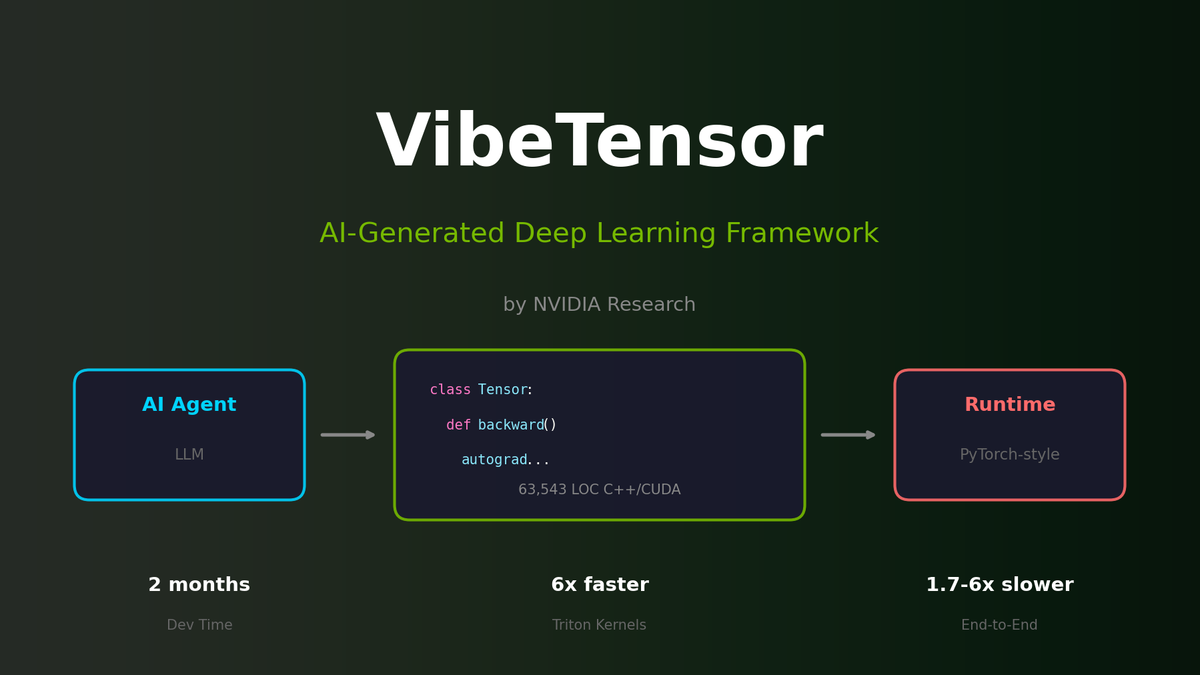
While LLMs writing code has become commonplace, what if AI agents could write an entire deep learning system software stack spanning tens of thousands of lines? VibeTensor, released by NVIDIA researchers, provides an answer to this question as an open-source project.
Today, we explore VibeTensor—a deep learning runtime fully generated by AI coding agents—examining its architecture, development methodology, and limitations.
What is VibeTensor?
VibeTensor is a deep learning system software stack implemented by LLM-powered coding agents under high-level human guidance. It's not a simple Python binding wrapper, but a complete runtime that includes a tensor/storage system, schema-free dispatcher, reverse-mode autograd engine, and CUDA memory management (streams, events, graphs).
Code Scale
Related Posts
LingBot-World: Enter the AI-Generated Matrix
LingBot-World from Ant Group is the first high-performance real-time world model released as open source. AI generates worlds in real-time based on keyboard input - we analyze this revolutionary project.
Qwen3-Max-Thinking Snapshot Release: A New Standard in Reasoning AI
The recent trend in the LLM market goes beyond simply learning "more data" — it's now focused on "how the model thinks." Alibaba Cloud has released an API snapshot (qwen3-max-2026-01-23) of its most powerful model, Qwen3-Max-Thinking.
YOLO26: Upgrade or Hype? The Complete Guide
Analyzing YOLO26's key features released in January 2026, comparing performance with YOLO11, and determining if it's worth upgrading through hands-on examples.