CFG-free Distillation: Fast Generation Without Guidance
Eliminating the 2x computational cost of CFG. Achieving same quality with single forward pass.
CFG-free Distillation: Fast Generation Without Guidance
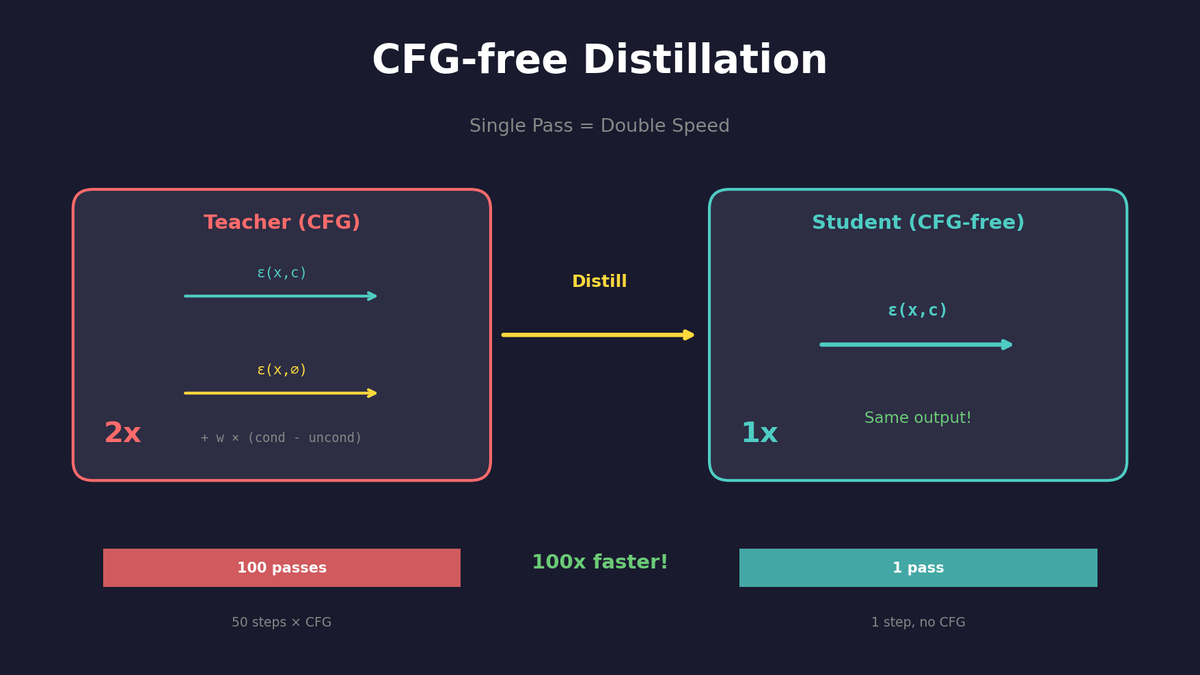
Eliminating the 2x computational cost of Classifier-Free Guidance. Achieving CFG quality with a single forward pass.
TL;DR
- Problem: CFG requires two forward passes (conditional + unconditional) = 2x cost
- Solution: Distill CFG effect into a single model
- Method: Student mimics Teacher's CFG output
- Result: Same quality, half the computation, faster inference
1. Classifier-Free Guidance Review
What is CFG?
The key technique for improving conditional generation quality:
- $\epsilon(x_t, c)$: Conditional prediction
- $\epsilon(x_t, \varnothing)$: Unconditional prediction
- $w$: Guidance scale (typically 7.5)
Problems with CFG
| Problem | Description |
|---|---|
| 2x Computation | Two forward passes per step |
| Memory Increase | Effective batch size doubled |
| Latency | Inference speed halved |
Critical for real-time applications!
2. CFG Distillation Idea
Key Insight
What if we train a model to **directly predict** the CFG output?
Teacher (with CFG):
2 forward passes → CFG combination → outputStudent (CFG-free):
1 forward pass → same outputDistillation Objective
Student mimics Teacher's CFG result.
3. Training Method
Basic Algorithm
def cfg_distillation_loss(student, teacher, x0, c, w=7.5):
    # Add noise
    t = torch.rand(x0.shape[0], device=x0.device)
    noise = torch.randn_like(x0)
    x_t = add_noise(x0, t, noise)

    # Teacher: Apply CFG
    with torch.no_grad():
        eps_cond = teacher(x_t, t, c)
        eps_uncond = teacher(x_t, t, null_cond)
        eps_cfg = eps_uncond + w * (eps_cond - eps_uncond)

    # Student: Single prediction
    eps_student = student(x_t, t, c)

    return F.mse_loss(eps_student, eps_cfg)
Guidance Scale Conditioning
To support various guidance scales:
def cfg_distillation_with_scale(student, teacher, x0, c):
    # Sample random guidance scale
    w = torch.rand(x0.shape[0], device=x0.device) * 10 + 1  # [1, 11]

    # Teacher CFG
    with torch.no_grad():
        eps_cfg = compute_cfg(teacher, x_t, t, c, w)

    # Student: scale as input
    eps_student = student(x_t, t, c, w)

    return F.mse_loss(eps_student, eps_cfg)
This allows adjustable guidance scale at inference!
4. Architecture Modifications
Guidance Scale Embedding
class CFGFreeUNet(nn.Module):
    def __init__(self, base_unet):
        super().__init__()
        self.unet = base_unet
        # Guidance scale embedding
        self.w_embed = nn.Sequential(
            nn.Linear(1, 256),
            nn.SiLU(),
            nn.Linear(256, 256)
        )

    def forward(self, x, t, c, w):
        # Add w to time embedding
        t_emb = self.time_embed(t)
        w_emb = self.w_embed(w.unsqueeze(-1))
        combined_emb = t_emb + w_emb

        return self.unet(x, combined_emb, c)
Or Simple Approach
If using fixed guidance scale only:
- No architecture modification needed
- Distill with specific w value
5. Combining with Progressive Distillation
CFG + Step Distillation
Approach used by SDXL-Turbo, SDXL-Lightning:
def combined_distillation(student, teacher, x0, c):
    # 1. Step distillation (2 steps → 1 step)
    t = sample_timestep()
    t_mid = t / 2

    x_t = add_noise(x0, t)

    # Teacher: 2 steps with CFG
    with torch.no_grad():
        # Step 1
        eps1 = compute_cfg(teacher, x_t, t, c, w=7.5)
        x_mid = denoise_step(x_t, eps1, t, t_mid)

        # Step 2
        eps2 = compute_cfg(teacher, x_mid, t_mid, c, w=7.5)
        x_target = denoise_step(x_mid, eps2, t_mid, 0)

    # Student: 1 step, no CFG
    x_pred = student.denoise(x_t, t, c)

    return F.mse_loss(x_pred, x_target)
Final Goal
| Model | Steps | CFG | Forward Passes |
|---|---|---|---|
| SD 1.5 | 50 | Yes | 100 |
| SDXL-Turbo | 1 | No | 1 |
100x speedup!
6. Implementation Example
Simple CFG-free Distillation
class CFGFreeDistillation:
    def __init__(self, student, teacher, guidance_scale=7.5):
        self.student = student
        self.teacher = teacher
        self.w = guidance_scale

        # Freeze teacher
        for p in teacher.parameters():
            p.requires_grad = False

    def compute_teacher_cfg(self, x_t, t, c):
        """Compute Teacher's CFG output"""
        # Conditional prediction
        eps_cond = self.teacher(x_t, t, c)

        # Unconditional prediction (null condition)
        null_c = torch.zeros_like(c)
        eps_uncond = self.teacher(x_t, t, null_c)

        # CFG combination
        return eps_uncond + self.w * (eps_cond - eps_uncond)

    def loss(self, x0, c):
        B = x0.shape[0]

        # Sample noise
        t = torch.rand(B, device=x0.device)
        noise = torch.randn_like(x0)

        # Forward diffusion
        sigma = t.view(B, 1, 1, 1)
        x_t = x0 + sigma * noise

        # Teacher CFG target
        with torch.no_grad():
            target = self.compute_teacher_cfg(x_t, t, c)

        # Student prediction
        pred = self.student(x_t, t, c)

        return F.mse_loss(pred, target)
Training Loop
def train_cfg_free(student, teacher, dataloader, epochs=100):
    distiller = CFGFreeDistillation(student, teacher)
    optimizer = torch.optim.AdamW(student.parameters(), lr=1e-4)

    for epoch in range(epochs):
        for images, captions in dataloader:
            # Text encoding
            c = text_encoder(captions)

            loss = distiller.loss(images, c)

            optimizer.zero_grad()
            loss.backward()
            optimizer.step()

        print(f"Epoch {epoch}: loss = {loss.item():.4f}")
7. Variational Score Distillation
Limitations
Limitations of simple distillation:
- Potential mode collapse
- Inherits Teacher's limitations
- Reduced diversity
VSD Approach
Using Score Distillation Sampling:
Adversarial Distillation
Adding GAN loss:
def adversarial_distillation_loss(student, teacher, discriminator, x0, c):
    # Distillation loss
    dist_loss = cfg_distillation_loss(student, teacher, x0, c)

    # Generate sample
    z = torch.randn_like(x0)
    x_gen = student.sample(z, c)

    # Adversarial loss
    adv_loss = -discriminator(x_gen, c).mean()

    return dist_loss + 0.1 * adv_loss
8. Real-World Models
SDXL-Turbo
Stability AI's approach:
- Adversarial Diffusion Distillation (ADD)
- CFG-free + 1-4 step generation
- Uses GAN discriminator
SDXL-Lightning
ByteDance's approach:
- Progressive distillation
- CFG distillation
- Efficient training with LoRA
LCM (Latent Consistency Models)
Consistency distillation + CFG:
- Consistency loss for step reduction
- Internalized CFG effect
9. Quality Comparison
Quantitative Results
| Model | Steps | CFG | FID | CLIP Score |
|---|---|---|---|---|
| SDXL | 50 | 7.5 | 23.5 | 0.32 |
| SDXL-Turbo | 1 | No | 24.1 | 0.31 |
| SDXL-Lightning | 4 | No | 23.8 | 0.32 |
| LCM-SDXL | 4 | No | 24.5 | 0.31 |
Nearly identical quality, overwhelming speed improvement!
Speed Comparison (A100)
| Model | Time/Image |
|---|---|
| SDXL 50 steps + CFG | 3.2s |
| SDXL-Turbo 1 step | 0.08s |
40x faster!
10. Limitations and Future
Current Limitations
| Limitation | Description |
|---|---|
| Teacher Dependency | Teacher quality is the ceiling |
| Training Cost | Requires large-scale data |
| Reduced Flexibility | Fixed or limited guidance scale |
Future Directions
- Self-Distillation: Self-improvement without Teacher
- Continuous Guidance: Support arbitrary w values
- Multi-Modal Guidance: Handle multiple conditions simultaneously
Conclusion
| Method | CFG Required | Steps | Speed |
|---|---|---|---|
| Basic Diffusion | Yes | 50+ | 1x |
| CFG Distillation | No | 50+ | 2x |
| + Step Distillation | No | 1-4 | 25-100x |
Key Points of CFG-free Distillation:
- Distill Teacher's CFG effect into Student
- Eliminate 2x computational overhead
- Combined with step distillation for 10-100x speedup
- Enables real-time image generation
References
- Sauer, A., et al. "Adversarial Diffusion Distillation" (2023)
- Lin, S., et al. "SDXL-Lightning" (2024)
- Luo, S., et al. "Latent Consistency Models" (2023)
- Ho, J., Salimans, T. "Classifier-Free Diffusion Guidance" (2022)
- Meng, C., et al. "On Distillation of Guided Diffusion Models" (CVPR 2023)
Subscribe to Newsletter
Related Posts
SDFT: Learning Without Forgetting via Self-Distillation
No complex RL needed. Models teach themselves to learn new skills while preserving existing capabilities.
Qwen3-Max-Thinking Snapshot Release: A New Standard in Reasoning AI
The recent trend in the LLM market goes beyond simply learning "more data" — it's now focused on "how the model thinks." Alibaba Cloud has released an API snapshot (qwen3-max-2026-01-23) of its most powerful model, Qwen3-Max-Thinking.
YOLO26: Upgrade or Hype? The Complete Guide
Analyzing YOLO26's key features released in January 2026, comparing performance with YOLO11, and determining if it's worth upgrading through hands-on examples.