Consistency Models: A New Paradigm for 1-Step Generation
Single-step generation without iterative sampling. OpenAI's innovative approach using self-consistency property.
Consistency Models: A New Paradigm for 1-Step Generation
Single-step generation without iterative sampling. OpenAI's innovative approach.
TL;DR
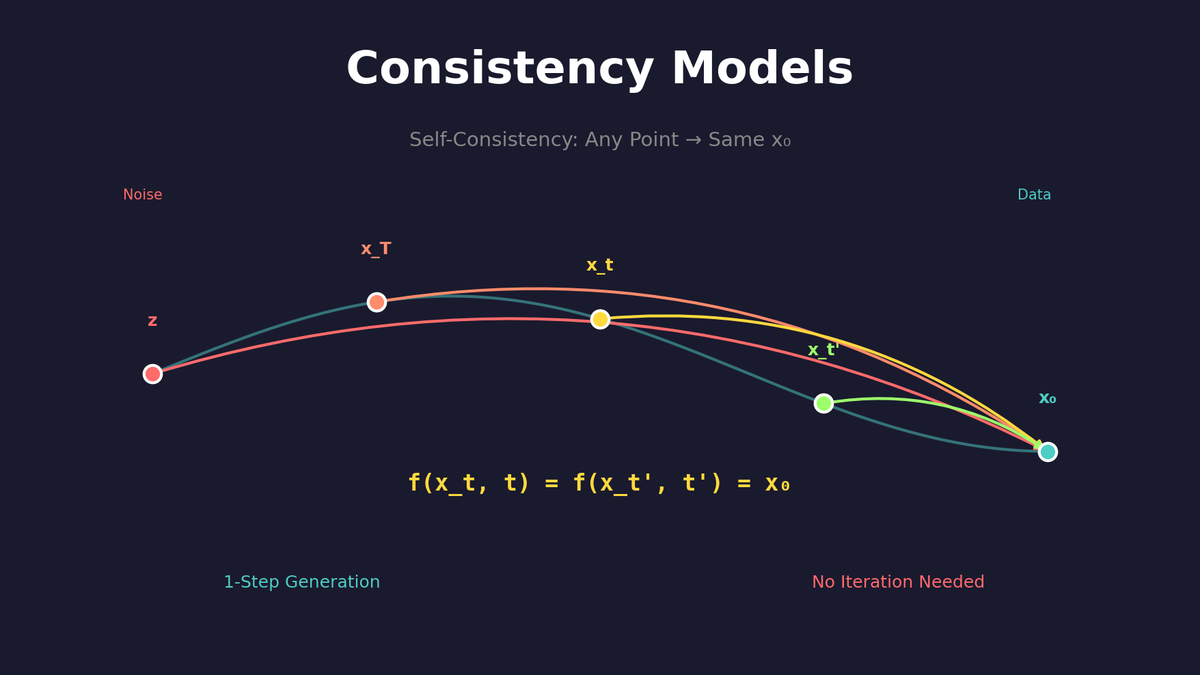
- Consistency Models: Map all points on the same trajectory to the same output
- Self-Consistency: $f(x_t, t) = f(x_{t'}, t')$ for all $t, t'$ on same trajectory
- Two Training Methods: Consistency Distillation (requires teacher) vs Consistency Training (no teacher)
- Result: High-quality 1-step generation, with optional multi-step for better quality
1. Why Consistency Models?
The Fundamental Limitation of Diffusion
Diffusion models require iterative sampling:
z ~ N(0,I) → x_T → x_{T-1} → ... → x_1 → x_0No matter how optimized:
- DDPM: 1000 steps
- DDIM: 50-100 steps
- DPM-Solver: 10-20 steps
Is 1-step impossible?
Problems with Existing Approaches
| Method | Problem |
|---|---|
| Progressive Distillation | Multiple distillation stages needed |
| Rectified Flow | Multiple reflow iterations needed |
| Direct 1-step training | Severe quality degradation |
The Consistency Models Idea
Key observation:
All points on an ODE trajectory converge to the **same data point**
Therefore:
Learn a function that outputs the **same result** regardless of starting point on trajectory!
2. Self-Consistency Property
Definition
A consistency function $f: (x_t, t) \to x_0$ satisfies:
when $x_t$ and $x_{t'}$ are on the same ODE trajectory.
Intuitive Understanding
Noise                                    Data
  z ─────●─────●─────●─────●─────> x_0
         ↓     ↓     ↓     ↓
        f()   f()   f()   f()
         ↓     ↓     ↓     ↓
         └─────┴─────┴─────┘
              All same x_0
Following the ODE leads to the same $x_0$, so predicting $x_0$ directly from any intermediate point should be possible.
Boundary Condition
At $t = 0$, should be identity:
If already at data, return as-is.
3. Consistency Model Architecture
Basic Structure
Design to satisfy boundary condition:
Where:
- $F_\theta$: Neural network (U-Net, DiT, etc.)
- $c_{\text{skip}}(t)$, $c_{\text{out}}(t)$: Time-dependent weights
Skip Connection Design
To satisfy $f(x, 0) = x$:
Common choice:
Time Embedding
For stability near $t \to 0$, transform time:
4. Consistency Distillation (CD)
Concept
Use a pre-trained diffusion model as teacher:
- Generate ODE trajectory with teacher
- Train consistency model to map different points on trajectory to same output
Algorithm
def consistency_distillation_loss(model, teacher, x0):
    # Sample time
    t = sample_timestep()
    t_next = t - delta_t  # one step earlier

    # Add noise to get x_t
    noise = torch.randn_like(x0)
    x_t = add_noise(x0, t, noise)

    # Teacher takes one ODE step: x_t -> x_{t_next}
    with torch.no_grad():
        x_t_next = teacher_ode_step(teacher, x_t, t, t_next)

    # Consistency loss: f(x_t, t) should equal f(x_{t_next}, t_next)
    pred_t = model(x_t, t)
    pred_t_next = model(x_t_next, t_next).detach()  # stop gradient

    return F.mse_loss(pred_t, pred_t_next)
Target Network (EMA)
For stable training, use target network:
- $\theta$: Training model
- $\theta^-$: EMA target (stop gradient)
- $\mu$: Decay rate (e.g., 0.999)
Loss Function
Where $d$ is a distance metric (L2, LPIPS, etc.).
5. Consistency Training (CT)
Learning Without a Teacher
Consistency Distillation requires a teacher model. But we can also learn without a teacher!
Key Idea
Instead of solving ODE exactly, enforce consistency at infinitesimal steps:
Algorithm
def consistency_training_loss(model, x0):
    # Sample time
    t = sample_timestep()
    t_next = t - delta_t

    # Add noise
    noise = torch.randn_like(x0)
    x_t = add_noise(x0, t, noise)
    x_t_next = add_noise(x0, t_next, noise)  # same noise!

    # Consistency loss
    pred_t = model(x_t, t)
    pred_t_next = model(x_t_next, t_next).detach()

    return F.mse_loss(pred_t, pred_t_next)
Key difference: Instead of teacher ODE step, sample at different times with same noise.
Why Does It Work?
When $\Delta t \to 0$:
This perturbation aligns with ODE direction. Thus enforcing consistency at infinitesimal steps implies consistency along entire trajectory.
CD vs CT Comparison
| Property | Consistency Distillation | Consistency Training |
|---|---|---|
| Teacher Model | Required | Not required |
| Training Difficulty | Easier | Harder |
| Final Quality | Higher | Slightly lower |
| Flexibility | Depends on teacher | Independent |
6. Sampling
1-Step Sampling
The simplest method:
def sample_one_step(model, z):
    # z ~ N(0, I)
    # Directly predict x_0
    return model(z, T)
Done! Generation without iteration.
Multi-Step Sampling (Quality Improvement)
For higher quality:
def sample_multi_step(model, z, timesteps):
    """
    timesteps: [T, t_1, t_2, ..., 0] (decreasing)
    """
    x = z

    for i in range(len(timesteps) - 1):
        t = timesteps[i]
        t_next = timesteps[i + 1]

        # Denoise to x_0
        x_0 = model(x, t)

        # Add noise back to t_next (if not last step)
        if t_next > 0:
            noise = torch.randn_like(x)
            x = add_noise(x_0, t_next, noise)

return x_0Principle:
- Predict $x_0$ from current $x_t$
- Add noise back to get $x_{t'}$
- Repeat
This alternates denoising and noise injection for quality improvement.
7. Implementation
Consistency Model Class
class ConsistencyModel(nn.Module):
    def __init__(self, network, sigma_data=0.5):
        super().__init__()
        self.network = network
        self.sigma_data = sigma_data

    def c_skip(self, t):
        return self.sigma_data**2 / (t**2 + self.sigma_data**2)

    def c_out(self, t):
        return t * self.sigma_data / torch.sqrt(t**2 + self.sigma_data**2)

    def forward(self, x, t):
        # Skip connection for boundary condition
        c_skip = self.c_skip(t)
        c_out = self.c_out(t)

        if c_skip.dim() == 1:
            c_skip = c_skip[:, None, None, None]
            c_out = c_out[:, None, None, None]

        F_x = self.network(x, t)

        return c_skip * x + c_out * F_x
Consistency Distillation Training
class ConsistencyDistillation:
    def __init__(self, model, teacher, ema_decay=0.999):
        self.model = model
        self.teacher = teacher
        self.target_model = copy.deepcopy(model)
        self.ema_decay = ema_decay

    def ode_step(self, x, t, t_next):
        """One step of teacher ODE."""
        with torch.no_grad():
            score = self.teacher(x, t)
            dt = t_next - t
            x_next = x + score * dt
        return x_next

    def loss(self, x0):
        B = x0.shape[0]

        # Sample timesteps
        t = torch.rand(B, device=x0.device) * (T - eps) + eps
        t_next = t - delta_t
        t_next = t_next.clamp(min=eps)

        # Forward diffusion
        noise = torch.randn_like(x0)
        x_t = x0 + t[:, None, None, None] * noise

        # Teacher ODE step
        x_t_next = self.ode_step(x_t, t, t_next)

        # Consistency loss
        pred = self.model(x_t, t)
        target = self.target_model(x_t_next, t_next)

        return F.mse_loss(pred, target)

    def update_target(self):
        """EMA update of target network."""
        with torch.no_grad():
            for p, p_target in zip(self.model.parameters(),
                                   self.target_model.parameters()):
                p_target.data.mul_(self.ema_decay).add_(
                    p.data, alpha=1 - self.ema_decay)
Consistency Training
class ConsistencyTraining:
    def __init__(self, model, ema_decay=0.999):
        self.model = model
        self.target_model = copy.deepcopy(model)
        self.ema_decay = ema_decay

    def loss(self, x0):
        B = x0.shape[0]

        # Sample timesteps
        t = torch.rand(B, device=x0.device) * (T - eps) + eps
        t_next = t - delta_t
        t_next = t_next.clamp(min=eps)

        # Same noise for both timesteps!
        noise = torch.randn_like(x0)
        x_t = x0 + t[:, None, None, None] * noise
        x_t_next = x0 + t_next[:, None, None, None] * noise

        # Consistency loss
        pred = self.model(x_t, t)
        target = self.target_model(x_t_next, t_next)

        return F.mse_loss(pred, target)
8. Improved Consistency Training (iCT)
Problems with Original CT
- Unstable early in training
- Error accumulation with large $\Delta t$
- Slow convergence
Improvements
- Adaptive $\Delta t$: Decrease $\Delta t$ during training
- Improved noise schedule: EDM-style noise schedule
- Better loss weighting: Time-dependent weighting
def adaptive_delta_t(step, total_steps):
    """Delta t decreases during training."""
    progress = step / total_steps
    return delta_t_max * (1 - progress) + delta_t_min * progress
9. Experimental Results
CIFAR-10 FID
| Model | NFE | FID |
|---|---|---|
| DDPM | 1000 | 3.17 |
| DDIM | 50 | 4.67 |
| Progressive Distillation | 1 | 9.12 |
| Consistency Distillation | 1 | 3.55 |
| Consistency Training | 1 | 5.83 |
ImageNet 64x64
| Model | NFE | FID |
|---|---|---|
| ADM | 250 | 2.07 |
| Consistency Distillation | 1 | 4.70 |
| Consistency Distillation | 2 | 2.93 |
Key Findings
- 1-step CD outperforms existing distillation methods
- 2-step significantly improves quality
- CT slightly lower than CD but requires no teacher
10. Latent Consistency Models (LCM)
Application to Stable Diffusion
Train Consistency Models in latent space:
# Encode to latent
z = vae.encode(image)

# Train consistency model in latent space
z_0_pred = consistency_model(z_t, t)

# Decode for visualization
image_pred = vae.decode(z_0_pred)
LCM Achievements
- 4 steps to match Stable Diffusion quality
- 5-10x speedup compared to original
- Compatible with CFG
LCM-LoRA
Efficient training with LoRA:
# Base SD model + LCM-LoRA
pipe = StableDiffusionPipeline.from_pretrained("...")
pipe.load_lora_weights("lcm-lora-sdv1-5")

# Fast generation
image = pipe(prompt, num_inference_steps=4).images[0]
Conclusion
| Method | Steps | Teacher Required | Quality |
|---|---|---|---|
| DDPM | 1000 | - | High |
| DDIM | 50 | - | High |
| Progressive Distill | 1-4 | Yes | Medium |
| Consistency Distill | 1-2 | Yes | High |
| Consistency Training | 1-2 | No | Medium-High |
| LCM | 4 | Yes | High |
Key to Consistency Models:
- Leverage self-consistency property
- Predict endpoint instead of learning ODE trajectory directly
- Enable 1-step generation while allowing multi-step for quality improvement
References
- Song, Y., et al. "Consistency Models" (ICML 2023)
- Song, Y., Dhariwal, P. "Improved Techniques for Training Consistency Models" (2023)
- Luo, S., et al. "Latent Consistency Models" (2023)
- Karras, T., et al. "Elucidating the Design Space of Diffusion-Based Generative Models" (NeurIPS 2022)
Subscribe to Newsletter
Related Posts
SDFT: Learning Without Forgetting via Self-Distillation
No complex RL needed. Models teach themselves to learn new skills while preserving existing capabilities.
Qwen3-Max-Thinking Snapshot Release: A New Standard in Reasoning AI
The recent trend in the LLM market goes beyond simply learning "more data" — it's now focused on "how the model thinks." Alibaba Cloud has released an API snapshot (qwen3-max-2026-01-23) of its most powerful model, Qwen3-Max-Thinking.
YOLO26: Upgrade or Hype? The Complete Guide
Analyzing YOLO26's key features released in January 2026, comparing performance with YOLO11, and determining if it's worth upgrading through hands-on examples.