From 512×512 to 1024×1024: How Latent Diffusion Broke the Resolution Barrier
How Latent Space solved the memory explosion problem of pixel-space diffusion. Complete analysis from VAE compression to Stable Diffusion architecture.
Latent Diffusion Models: The Core Principles of Stable Diffusion
TL;DR: Latent Diffusion performs diffusion in a compressed latent space instead of pixel space. This made high-resolution image generation practically possible and became the foundation technology for Stable Diffusion.
1. Why Latent Space?
1.1 The Problem with Pixel Space
Limitations of DDPM/DDIM:

| Resolution | Pixels | U-Net Parameters | GPU Memory |
|---|---|---|---|
| 64×64 | 12,288 | ~100M | ~4GB |
| 256×256 | 196,608 | ~400M | ~16GB |
| 512×512 | 786,432 | ~900M | ~40GB |
| 1024×1024 | 3,145,728 | ~2B | ~160GB |
Problem: Computation explodes at high resolution
1.2 Key Insight
Rombach et al.'s discovery:
"Most information in images lies in low-dimensional structures. High-frequency details are perceptually important but semantically redundant."
Intuition:
- 512×512 RGB image = 786,432 dimensions
- But "meaningful" information fits in far fewer dimensions
- Let's perform diffusion in this compressed representation!
1.3 Two-Stage Approach
Stage 1: Autoencoder (trained once) - The encoder compresses a 512×512×3 image into a 64×64×4 latent representation. The decoder reconstructs the image from this latent space back to 512×512×3.
Stage 2: Diffusion in Latent Space - The U-Net operates entirely in the compressed latent space, transforming noise into clean latents. The decoder then converts these clean latents into the final generated image.
2. Autoencoder: Image Compression
2.1 VAE (Variational Autoencoder)
LDM uses VAE to compress images:
Encoder :
Decoder :
Compression Ratio (Stable Diffusion):
- Input: 512×512×3 = 786,432
- Latent: 64×64×4 = 16,384
- 48x compression!
2.2 VAE Training Objective
def vae_loss(x, z, x_recon, z_mean, z_logvar):
    # 1. Reconstruction Loss
    recon_loss = F.mse_loss(x_recon, x)

    # 2. Perceptual Loss (LPIPS)
    perceptual_loss = lpips(x_recon, x)

    # 3. KL Divergence (regularization)
    kl_loss = -0.5 * torch.mean(1 + z_logvar - z_mean.pow(2) - z_logvar.exp())

    # 4. Adversarial Loss (optional, for sharpness)
    adv_loss = discriminator_loss(x_recon)

    return recon_loss + 0.5 * perceptual_loss + 0.001 * kl_loss + 0.1 * adv_loss
2.3 KL-regularized Autoencoder
Differences from standard VAE:
Standard VAE:
- (sampling required)
- Reconstruction can be blurry
LDM's KL-reg VAE:
- Very small KL weight (0.00001)
- Works nearly deterministically
- Maintains sharp reconstruction
class KLRegularizedVAE(nn.Module):
    def __init__(self, ...):
        self.encoder = Encoder(...)
        self.decoder = Decoder(...)

    def encode(self, x):
        h = self.encoder(x)
        mean, logvar = h.chunk(2, dim=1)

        # Reparameterization (during training)
        std = torch.exp(0.5 * logvar)
        z = mean + std * torch.randn_like(std)

        return z, mean, logvar

    def decode(self, z):
        return self.decoder(z)

    def forward(self, x):
        z, mean, logvar = self.encode(x)
        x_recon = self.decode(z)
        return x_recon, mean, logvar
2.4 VQ-VAE Alternative
Some LDMs use VQ-VAE (Vector Quantized VAE):
Advantages:
- Discrete latent space
- Better reconstruction
- No posterior collapse
Disadvantages:
- Requires codebook training
- Additional complexity
3. Latent Diffusion Process
3.1 Forward Process in Latent Space
Diffusion on latent instead of original image :
3.2 Reverse Process
Denoising in latent space:
3.3 Training Objective
def ldm_training_step(model, vae, x, condition=None):
    # 1. Encode image to latent
    with torch.no_grad():
        z = vae.encode(x)

    # 2. Add noise
    t = torch.randint(0, T, (batch_size,))
    noise = torch.randn_like(z)
    z_t = sqrt(alpha_bar[t]) * z + sqrt(1 - alpha_bar[t]) * noise

    # 3. Predict noise
    noise_pred = model(z_t, t, condition)

    # 4. Loss
    loss = F.mse_loss(noise_pred, noise)

    return loss
3.4 Sampling
@torch.no_grad()
def ldm_sample(model, vae, shape, condition=None, num_steps=50):
    # 1. Start in latent space
    z = torch.randn(shape)  # (batch, 4, 64, 64)

    # 2. Diffusion reverse process (DDIM)
    for t in tqdm(reversed(range(num_steps))):
        noise_pred = model(z, t, condition)
        z = ddim_step(z, t, noise_pred)

    # 3. Decode latent to image
    images = vae.decode(z)

    return images
4. Conditioning Mechanisms
4.1 Cross-Attention for Text Conditioning
The key mechanism for injecting text conditions into U-Net:
Where:
- : Generated from latent features
- : Generated from text embeddings
class CrossAttention(nn.Module):
    def __init__(self, query_dim, context_dim, heads=8, dim_head=64):
        super().__init__()
        inner_dim = dim_head * heads

        self.to_q = nn.Linear(query_dim, inner_dim, bias=False)
        self.to_k = nn.Linear(context_dim, inner_dim, bias=False)
        self.to_v = nn.Linear(context_dim, inner_dim, bias=False)
        self.to_out = nn.Linear(inner_dim, query_dim)

        self.heads = heads
        self.scale = dim_head ** -0.5

    def forward(self, x, context):
        # x: (batch, seq_len, query_dim) - latent features
        # context: (batch, context_len, context_dim) - text embeddings

        q = self.to_q(x)
        k = self.to_k(context)
        v = self.to_v(context)

        # Multi-head reshape
        q, k, v = map(lambda t: rearrange(t, 'b n (h d) -> b h n d', h=self.heads), (q, k, v))

        # Attention
        attn = torch.matmul(q, k.transpose(-1, -2)) * self.scale
        attn = F.softmax(attn, dim=-1)

        out = torch.matmul(attn, v)
        out = rearrange(out, 'b h n d -> b n (h d)')

        return self.to_out(out)
4.2 Text Encoder
Stable Diffusion uses CLIP text encoder:
class TextEncoder:
    def __init__(self, model_name="openai/clip-vit-large-patch14"):
        self.tokenizer = CLIPTokenizer.from_pretrained(model_name)
        self.model = CLIPTextModel.from_pretrained(model_name)

    def encode(self, text):
        tokens = self.tokenizer(
            text,
            padding="max_length",
            max_length=77,
            truncation=True,
            return_tensors="pt"
        )

        with torch.no_grad():
            embeddings = self.model(tokens.input_ids)[0]

        return embeddings  # (batch, 77, 768)
4.3 Classifier-Free Guidance (CFG)
The key technique for improving conditional generation quality:
Where:
- : guidance scale (typically 7.5)
- : condition (text embedding)
- : null condition (empty text)
def cfg_sample_step(model, z_t, t, text_emb, null_emb, guidance_scale=7.5):
    # Unconditional prediction
    noise_uncond = model(z_t, t, null_emb)

    # Conditional prediction
    noise_cond = model(z_t, t, text_emb)

    # CFG combination
    noise_pred = noise_uncond + guidance_scale * (noise_cond - noise_uncond)

    return noise_pred
5. U-Net Architecture for LDM
5.1 Overall Structure
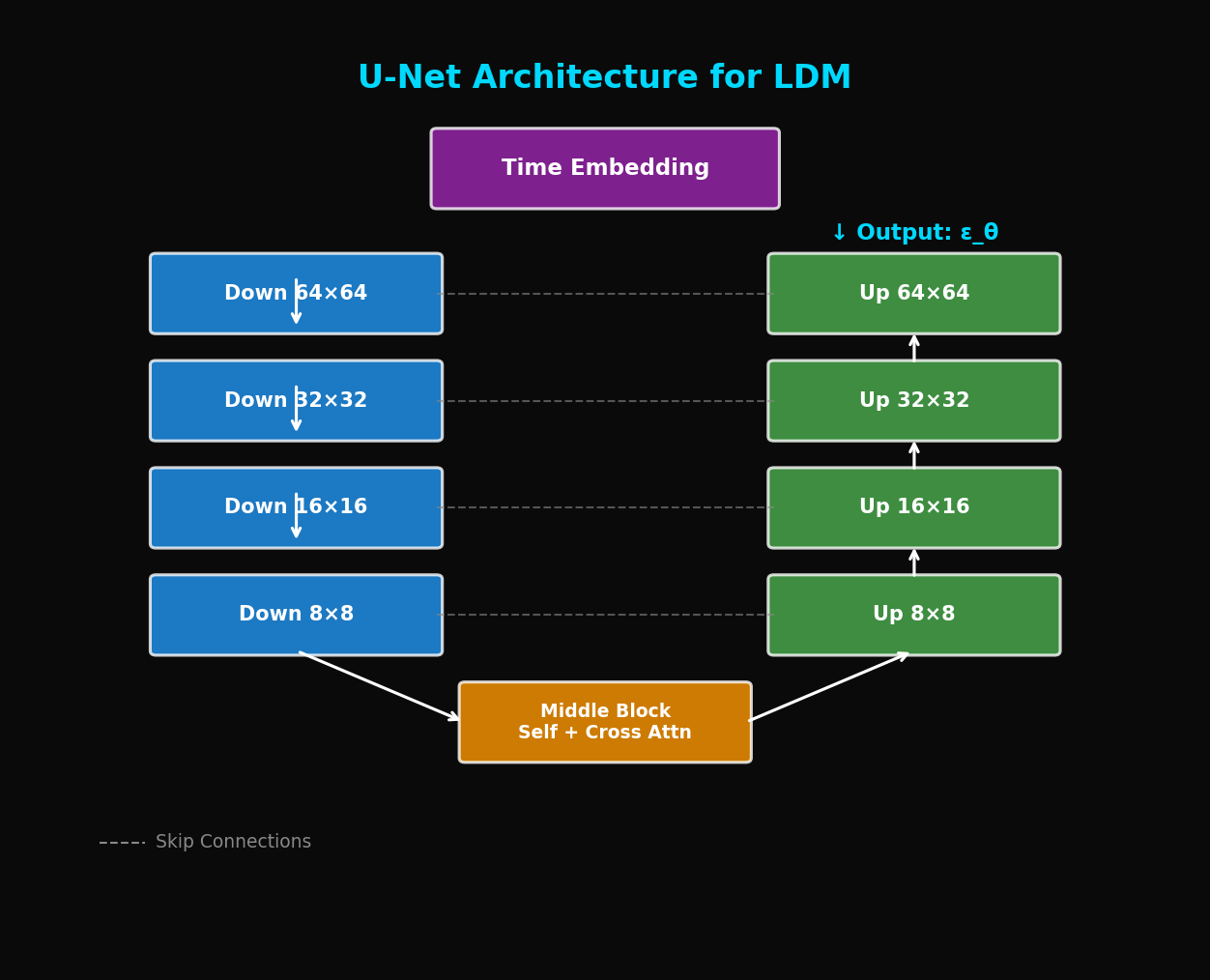
Input: z_t (64×64×4), t, text_emb
The U-Net architecture processes latents through three main stages: (1) Down Blocks with ResBlocks and Attention that progressively reduce spatial dimensions from 64×64 to 32×32 to 16×16 to 8×8, (2) a Middle Block containing ResBlock, Self-Attention, and Cross-Attention, and (3) Up Blocks with skip connections that restore spatial dimensions from 8×8 back to 64×64. Time embeddings condition every block, and the output predicts the noise ε_θ.
5.2 Transformer Block in U-Net
class BasicTransformerBlock(nn.Module):
    def __init__(self, dim, num_heads, context_dim):
        super().__init__()
        self.attn1 = CrossAttention(dim, dim, num_heads)  # Self-attention
        self.attn2 = CrossAttention(dim, context_dim, num_heads)  # Cross-attention
        self.ff = FeedForward(dim)

        self.norm1 = nn.LayerNorm(dim)
        self.norm2 = nn.LayerNorm(dim)
        self.norm3 = nn.LayerNorm(dim)

    def forward(self, x, context):
        # Self-attention (latent features attend to themselves)
        x = x + self.attn1(self.norm1(x), self.norm1(x))

        # Cross-attention (latent features attend to text)
        x = x + self.attn2(self.norm2(x), context)

        # Feed-forward
        x = x + self.ff(self.norm3(x))

        return x
5.3 ResBlock with Time Embedding
class ResBlock(nn.Module):
    def __init__(self, in_channels, out_channels, time_emb_dim):
        super().__init__()
        self.norm1 = nn.GroupNorm(32, in_channels)
        self.conv1 = nn.Conv2d(in_channels, out_channels, 3, padding=1)
        self.time_emb_proj = nn.Linear(time_emb_dim, out_channels)
        self.norm2 = nn.GroupNorm(32, out_channels)
        self.conv2 = nn.Conv2d(out_channels, out_channels, 3, padding=1)

        if in_channels != out_channels:
            self.skip_connection = nn.Conv2d(in_channels, out_channels, 1)
        else:
            self.skip_connection = nn.Identity()

    def forward(self, x, time_emb):
        h = self.norm1(x)
        h = F.silu(h)
        h = self.conv1(h)

        # Add time embedding
        h = h + self.time_emb_proj(F.silu(time_emb))[:, :, None, None]

        h = self.norm2(h)
        h = F.silu(h)
        h = self.conv2(h)

        return h + self.skip_connection(x)
6. Experimental Results
6.1 ImageNet 256×256
| Model | FID ↓ | IS ↑ | Parameters |
|---|---|---|---|
| BigGAN | 7.4 | 171.4 | 160M |
| ADM (pixel) | 4.59 | 186.7 | 554M |
| **LDM-4** | **3.60** | **247.7** | **400M** |
LDM achieves better performance with fewer parameters!
6.2 Text-to-Image (MS-COCO)
| Model | FID ↓ | CLIP Score ↑ |
|---|---|---|
| DALL-E | 27.5 | - |
| GLIDE | 12.2 | 0.32 |
| **Stable Diffusion** | **7.3** | **0.35** |
6.3 Computational Efficiency
| Method | Resolution | Training (GPU days) | Sampling Time |
|---|---|---|---|
| ADM | 256×256 | 2000 | 250s |
| **LDM** | 256×256 | **100** | **10s** |
| ADM | 512×512 | 4000+ | 500s+ |
| **LDM** | 512×512 | **200** | **15s** |
20x more efficient training, 25x faster sampling
7. Stable Diffusion Architecture
7.1 Component Configuration
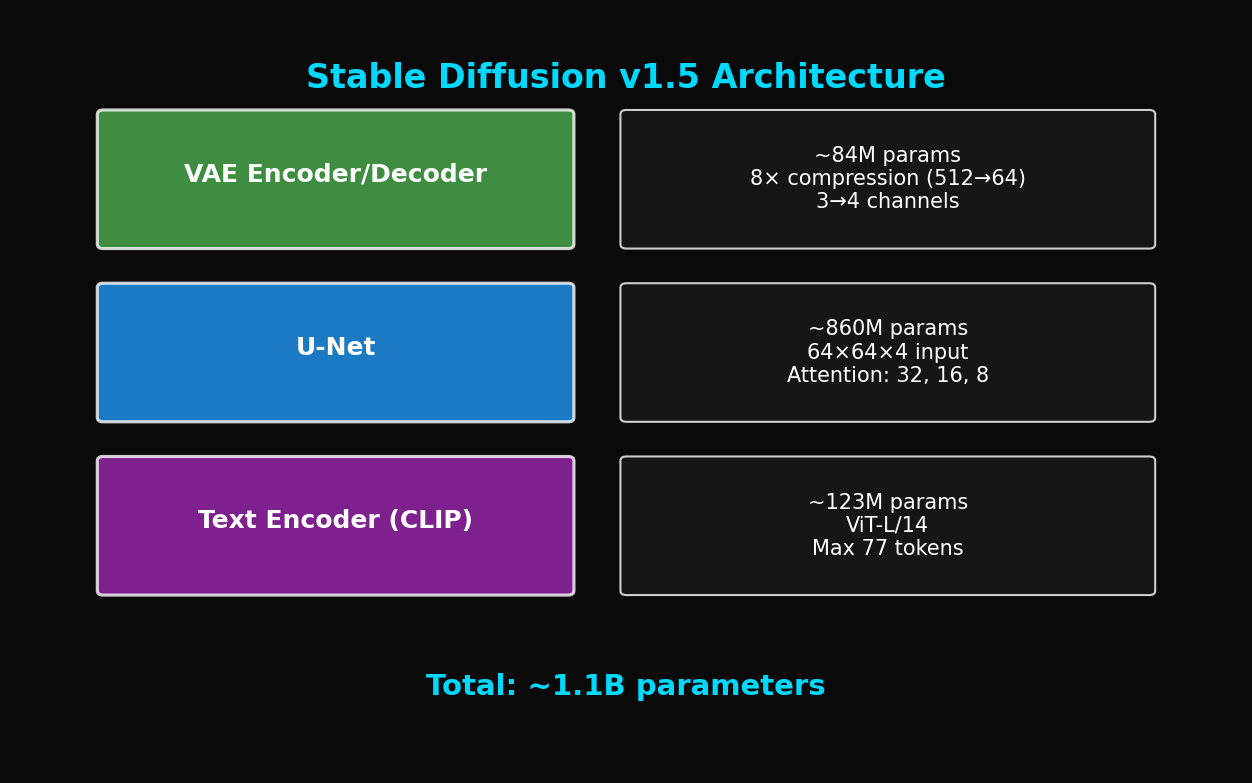
Stable Diffusion v1.5 specifications: VAE Encoder/Decoder (~84M parameters) with 8× compression (512→64) and 3→4 channels. U-Net (~860M parameters) with 64×64×4 input and attention at resolutions 32, 16, 8. Text Encoder uses CLIP ViT-L/14 (~123M parameters) with max 77 tokens. Total: approximately 1.1B parameters.
7.2 Complete Pipeline
class StableDiffusion:
    def __init__(self):
        self.vae = AutoencoderKL.from_pretrained("...")
        self.unet = UNet2DConditionModel.from_pretrained("...")
        self.text_encoder = CLIPTextModel.from_pretrained("...")
        self.scheduler = DDIMScheduler(...)

    @torch.no_grad()
    def generate(self, prompt, num_steps=50, guidance_scale=7.5):
        # 1. Text encoding
        text_emb = self.encode_text(prompt)
        null_emb = self.encode_text("")

        # 2. Initial latent
        latent = torch.randn(1, 4, 64, 64)

        # 3. Denoising loop
        self.scheduler.set_timesteps(num_steps)
        for t in self.scheduler.timesteps:
            # Classifier-free guidance
            latent_input = torch.cat([latent] * 2)
            text_input = torch.cat([null_emb, text_emb])

            noise_pred = self.unet(latent_input, t, text_input).sample
            noise_uncond, noise_cond = noise_pred.chunk(2)
            noise_pred = noise_uncond + guidance_scale * (noise_cond - noise_uncond)

            # Scheduler step
            latent = self.scheduler.step(noise_pred, t, latent).prev_sample

        # 4. Decode
        image = self.vae.decode(latent / 0.18215).sample

        return image
8. Advanced Techniques
8.1 ControlNet
Inject additional conditions (pose, edge, depth):
class ControlNet(nn.Module):
    def __init__(self, unet):
        super().__init__()
        # Clone U-Net's encoder part
        self.controlnet_encoder = copy.deepcopy(unet.encoder)

        # Zero convolution (zero output at initialization)
        self.zero_convs = nn.ModuleList([
            nn.Conv2d(ch, ch, 1) for ch in encoder_channels
        ])
        for conv in self.zero_convs:
            nn.init.zeros_(conv.weight)
            nn.init.zeros_(conv.bias)

    def forward(self, z_t, t, text_emb, control_image):
        # Pass control image through encoder
        control_features = self.controlnet_encoder(control_image, t)

        # Apply zero conv and add to U-Net
        control_outputs = [
            zero_conv(feat) for zero_conv, feat in zip(self.zero_convs, control_features)
        ]

        return control_outputs  # Added to U-Net's skip connections
8.2 LoRA (Low-Rank Adaptation)
Efficient fine-tuning:
class LoRALinear(nn.Module):
    def __init__(self, original_linear, rank=4, alpha=1.0):
        super().__init__()
        self.original = original_linear
        in_features = original_linear.in_features
        out_features = original_linear.out_features

        # Low-rank matrices
        self.lora_A = nn.Parameter(torch.randn(rank, in_features) * 0.01)
        self.lora_B = nn.Parameter(torch.zeros(out_features, rank))

        self.scale = alpha / rank

    def forward(self, x):
        original_out = self.original(x)
        lora_out = (x @ self.lora_A.T) @ self.lora_B.T * self.scale
        return original_out + lora_out
8.3 SDXL Improvements
Key changes in Stable Diffusion XL:
| Component | SD 1.5 | SDXL |
|---|---|---|
| Resolution | 512×512 | 1024×1024 |
| U-Net Parameters | 860M | 2.6B |
| Text Encoder | CLIP ViT-L | CLIP ViT-G + OpenCLIP ViT-bigG |
| Refiner | None | Separate model |
9. Practical Tips
9.1 Prompt Engineering
# Good prompt example
good_prompt = """
a beautiful sunset over mountains,
highly detailed, 8k resolution,
professional photography,
golden hour lighting,
award winning photo
"""

# Bad prompt example
bad_prompt = "sunset mountains"
9.2 Using Negative Prompts
negative_prompt = """
blurry, low quality, distorted,
bad anatomy, watermark, signature,
out of frame, cropped
"""

# During generation
image = pipe(
    prompt=positive_prompt,
    negative_prompt=negative_prompt,
    guidance_scale=7.5
).images[0]
9.3 Optimal Parameters
| Parameter | Recommended Range | Effect |
|---|---|---|
| guidance_scale | 7-12 | Higher = more prompt adherence |
| num_steps | 20-50 | More = higher quality, slower |
| seed | Fixed | Reproducibility |
10. Conclusion
Latent Diffusion Models led the democratization of generative AI:
- Efficiency: High resolution possible with 48x compression
- Quality: Achieved SOTA FID/IS
- Flexibility: Various conditioning possible
- Accessibility: Runs on consumer GPUs
The open-source release of Stable Diffusion changed the landscape of image generation AI. In the next article, we'll cover DiT (Diffusion Transformer): a new paradigm replacing U-Net with Transformer.
References
- Rombach, R., et al. (2022). High-Resolution Image Synthesis with Latent Diffusion Models. CVPR 2022
- Podell, D., et al. (2023). SDXL: Improving Latent Diffusion Models for High-Resolution Image Synthesis. arXiv
- Zhang, L., et al. (2023). Adding Conditional Control to Text-to-Image Diffusion Models. ICCV 2023
- Hu, E., et al. (2022). LoRA: Low-Rank Adaptation of Large Language Models. ICLR 2022
Tags: #Latent-Diffusion #Stable-Diffusion #VAE #Cross-Attention #CFG #Text-to-Image #Deep-Learning
The complete code for this article is available in the attached Jupyter Notebook.
Subscribe to Newsletter
Related Posts
SDFT: Learning Without Forgetting via Self-Distillation
No complex RL needed. Models teach themselves to learn new skills while preserving existing capabilities.
Qwen3-Max-Thinking Snapshot Release: A New Standard in Reasoning AI
The recent trend in the LLM market goes beyond simply learning "more data" — it's now focused on "how the model thinks." Alibaba Cloud has released an API snapshot (qwen3-max-2026-01-23) of its most powerful model, Qwen3-Max-Thinking.
YOLO26: Upgrade or Hype? The Complete Guide
Analyzing YOLO26's key features released in January 2026, comparing performance with YOLO11, and determining if it's worth upgrading through hands-on examples.