LangGraph in Practice — Reflection Agents and Planning Patterns
Auto-validate agent outputs with Self-Critique and systematically decompose complex tasks with Planning patterns. Implementing Generator-Reflector architecture and Plan-and-Execute.
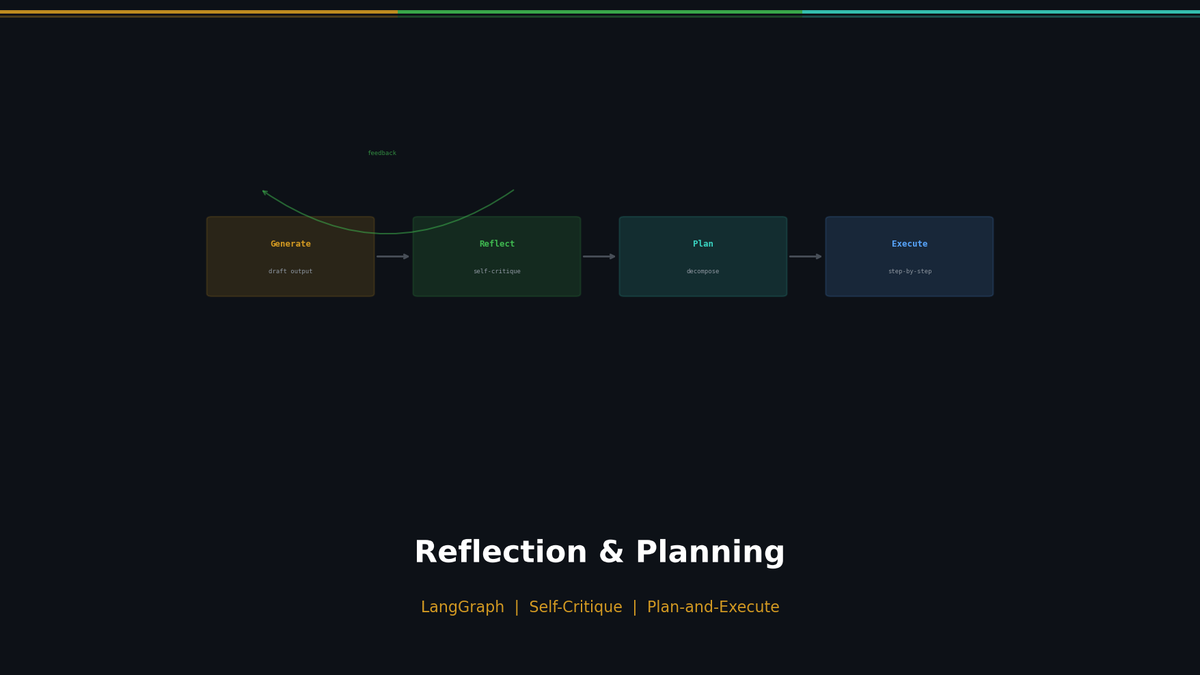
LangGraph in Practice — Reflection Agent and Planning Patterns
The ReAct Agent we built in Part 1 has one critical weakness: it doesn't know when it's wrong. Even if it answers "Seoul's population is 50 million," it remains fully confident. The Reflection pattern gives agents the ability to self-verify. And the Planning pattern gives them the ability to systematically decompose complex tasks.
Series: Part 1: ReAct Pattern | Part 2 (this post) | Part 3: MCP + Multi-Agent | Part 4: Production Deployment
Self-Critique: How Agents Verify Their Own Output
People revise their writing after a first draft. A first draft is rarely perfect. The same goes for LLM Agents. Expecting a perfect answer in one shot is unrealistic — building a loop where the agent verifies and improves its own output leads to markedly better quality.
Related Posts
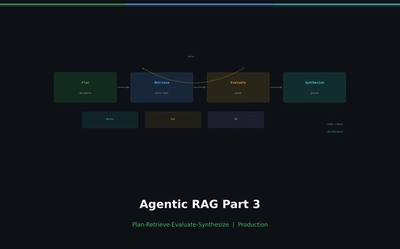
Agentic RAG Pipeline — Multi-step Retrieval in Production
Build a full Plan-Retrieve-Evaluate-Synthesize pipeline. Unify vector search, web search, and SQL as agent tools. Add hallucination detection and source grounding.
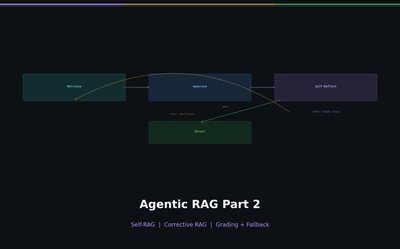
Self-RAG and Corrective RAG — The Agent Evaluates Its Own Retrieval
Implement Self-RAG reflection tokens and CRAG quality-based fallback. Build retry/fallback logic with LangGraph conditional edges.
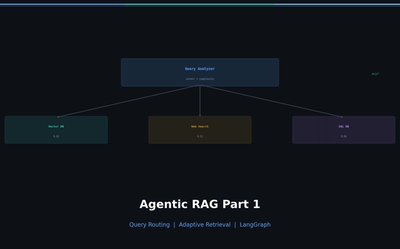
Why Agentic RAG? — Query Routing and Adaptive Retrieval
Diagnose naive RAG limitations, classify query intent, and route to the optimal retrieval source with LangGraph. Implement adaptive retrieval that skips unnecessary searches.